
From demonstration of dictatorship to celebration of neoliberalism
Invented by World War I veteran Jules Rimet, this international competition takes place after the creation of the FIFA in 1904, and took place for the first time in 1930. In Rimet’s mind, the only purpose of the FIFA and its competitions was to “create communication and collaboration between countries through the worldwide sport of football”. After the founding tournament in Uruguay in front of 2000 people, the events took a rapid turn with the 1934 Italian World Cup with open demonstrations of Mussolini’s fascism with matches preceded by roman salutes and wore black shirts similar to those of the paramilitary wing of Italian Fascism (Squadristi). Furthermore, the 1938 German World cup featured a team singing Deutschland über alles (German national anthem) over a Nazi salute, featuring players from all the territories Germany had annexed at the time. Historically, FIFA was off to a bad start.
After World War II, the World Cup was again an attempt at peace. At the same time, the number of viewers increased exponentially – 65,000 people were sitting in Berne for the 1954 final. In the 1960s, the nomination of João Havelange as head of the FIFA helped with inclusion of African and Asian nations, as previously only one team from each continent was allowed to participate. Along the years, tourism increased along with the number of teams. The commercial aspect also flourished with TV and advertising. With all this new activity, the World Cup became an event of high interest for nations, a tool of soft power for governments and an economic driver. The tournament is an example of hyper globalization, today the World Cup (together with continental tournaments and the Olympic games) are indeed considered mega-events. The tournament accelerates economic integration through transnational sponsorships, media rights markets, and globally coordinated infrastructure projects. Portrayed as apolitical celebrations of national pride, mega-events are 21st century Trojan horses, and carry inside them all the hidden tricks of shameless neoliberalism restructuring. Behind the festive façade, they facilitate the expansion of the private sector through public–private partnerships, real-estate speculation, and the commodification of urban space. Where States assume the costs, private actors capture the profits. In the Qatar World Cup of 2022, more than 3 million spectators contributed to 5 billion dollars in revenue for the event.
Do the host country’s citizens benefit from these revenues ?
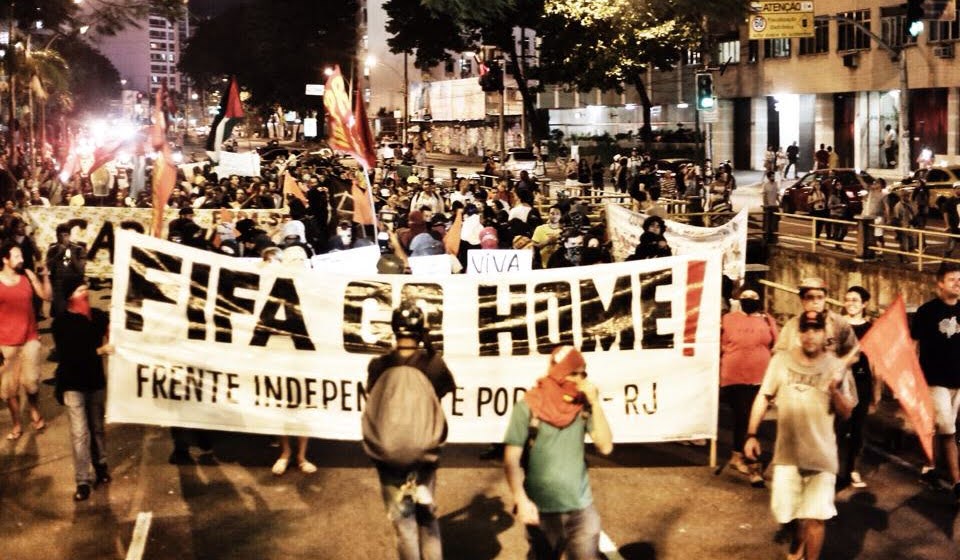
A logical assumption would be that the population of the host country (the host cities at least!) gain from this exceptional economic inflow. However, if we weigh all consequences on the population, we can see the opposite is actually true. If host countries receive (heavy) subsidies from FIFA, a lot of the transformation on site will allegedly benefit the population and is therefore financed by the government’s budget. In other words, part of these events are financed by the citizens’ taxes, often raised before the competition and affecting the people’s purchasing power. If we think of new subways or training facilities,how can this not benefit the population, right? Except, by looking at the past competitions, these constructions seem, for the most part, reckless. In Brazil in 2014, FIFA constructions were nicknamed “White Elephants” as it is very clear that no attention was paid to the actual city of Rio during the building process… Stadiums financed by the government are now used as parking lots or can be rented to throw gigantic birthday parties or weddings. These brand new stadiums stand next to underfunded hospitals and schools, sharing underdeveloped facilities and too little capacity for the needs of the city. This led to riots in the city, especially around the favelas (in Brazil, an informal urban settlement that is built without oversight from public authority […] characterized by self-built housing, incremental construction, and limited access historically and currently to state-provided services Britannica) in which mass displacements of people happened, with mottos such as : “We want FIFA standard hospitals” or “FIFA go home”. Likewise, in Qatar as well, entire cities appeared from out of the ground with the sole purpose of welcoming the World Cup spectators…They are now ghost cities, constructed for an event that ended a long time ago. Every host country has a similar story…
Environmental consequences
The carbon footprint of these events is so large that it is often difficult to understand for anyone who is not highly aware about carbon emissions. With all the constructions – the mobility of players, public, staff, the electricity ( AC in open-air facilities…) – one can only imagine the scale of pollution generated. In Qatar the official number was 3.6 million tonnes of CO₂, with only 1.8 million of carbon credits bought. By comparison, that is 75% of the total annual emissions in Paris – and the World Cup lasts only a month. NGOs estimate that the competition’s emissions were closer to 6 million tonnes, 10 million for the highest estimates EU factcheck). We also need to take into account the deforestation created by construction; biodiversity disturbance; land degradation; water stress; high demand in resource extraction. These impacts reveal how mega-events concentrate and accelerate environmental harm, exposing the structural incompatibility between the growth-oriented logic of global sporting spectacles and the goals of ecological sustainability.
Sure not legitimate, but maybe legal?
The numerous legal abuses around this competition can be proven easily. The most prominent one is the disregard of human rights rights, especially with labor conditions: the strict FIFA requirements to convene in very short order forces the demand for labor to rise specularly. On construction sites, the number of workers is insufficient, resulting in much overtime work. Working over hours in a country such as Qatar does not mean overtime pay – instead workers continue to work in harsh conditions with no possibility to discuss these conditions, no chance to defend one’s own rights. A study by The Guardian counted more than 6500 deaths among those workers, mainly workers who came from abroad (India, Pakistan, Nepal, Bangladesh and Sri Lanka) given the high work demand.
Furthermore, over the years, there have been multiple instances of constitutional overreach (during the World Cup and the Olympics). Noami Klein conceptualized these cases as “ shock doctrine” which was then applied by Dave Zirin to IOC/FIFA relations with Brazil, and named “sporting shock doctrine, evoking how the exceptional time-bound and hypernationalist context allow governments to pass legislation that would have been much more contested otherwise. In South Africa, during the 2010 World Cup, marches and public assemblies were forbidden and cases of police harassment and arbitrary arrests increased. We have also seen many cases of hyper surveillance dedicated for the events (here especially during the Olympics like in London in 2012 or in Paris in 2024) or hyper militarization as seen in Brazil where the police killed 1/229 suspects in 2014, in the US, for comparison, it was 1/31 575.
What about 2026 ?
We can expect that the environmental consequences of staging the World Cup this summer will be high once again. Pollution will surely be high, especially given the need for huge mobility around the different cities, and an increase in air travel. Secondly, the political situation in the United States raises a lot of questions about migration policy, surveillance, and civil liberties. The likely presence of ICE around stadiums and fan zones could create fear among migrant communities and discourage attendance or encourage protest, deepening the state of fear in the country. As seen in previous mega-events, we can expect a high overall militarization and new surveillance methods.
As said by Simon Kuper, “Football is never just football”. The World Cup is inherently political and possesses an extensive record of disregarding human rights, abuse of the environment, and constitutional overreach. In 2026, will you boycott, or will you finance ?
Bibliography
Zirin, Dave. Brazil’s Dance with the Devil: The World Cup, the Olympics, and the Fight for Democracy. Chicago: Haymarket Books, 2016.
Le Monde. “Qatar 2022 : la promesse de « neutralité carbone » de la Coupe du monde n’est pas crédible.” October 29, 2022.
https://www.lemonde.fr/les-decodeurs/article/2022/10/29/qatar-2022-la-promesse-de-neutralite-carbone-de-la-coupe-du-monde-n-est-pas-credible_6147831_4355770.html
France Culture. “La coupe du monde au Qatar : entre mondial et malaise.” November 27, 2022.
https://www.radiofrance.fr/franceculture/podcasts/l-esprit-public/la-coupe-du-monde-au-qatar-entre-mondial-et-malaise-5012066
Pattisson, Pete, Niamh McIntyre, and Imran Mukhtar. “Revealed: 6,500 Migrant Workers Have Died in Qatar since World Cup Awarded.” The Guardian, February 23, 2021.
https://www.theguardian.com/global-development/2021/feb/23/revealed-migrant-worker-deaths-qatar-fifa-world-cup-2022
Mike Berners-Lee, quoted in EU Fact Check, “Mostly False: The 2022 FIFA World Cup in Qatar Is Fully Carbon Neutral,” EUfactcheck.eu, November 17, 2022, https://eufactcheck.eu/factcheck/mostly-false-the-2022-fifa-world-cup-in-qatar-is-fully-carbon-neutral/
Cover Image: Thiago Dezan/NINJA
Other posts that may interest you:
Discover more from The Sundial Press
Subscribe to get the latest posts sent to your email.