
During communist rule in Romania, a new stamp with the face of President Nicolae Ceaușescu was being produced. One day, Ceaușescu decides to visit a post office in disguise and see how it was selling.
“No one’s buying it”, says the clerk.
“Why not?” says Ceaușescu.
“It’s not sticking”.
Ceaușescu proceeds to spit on the back of the stamp, sticks it on an envelope and says: “What do you mean? Can’t you see it sticked?”.
“Well yes, but people usually spit on the other side.”
Recently, I was looking through my late great-grandfather’s journals from 60 years ago. I find it fascinating – how people close to me reacted to events we now study in history books. Eventually, I found an entry from August 20th, 1968. He simply wrote: “Today, Czechoslovakia was invaded.” referring to the country being attacked by the Warsaw Pact (a collective defense treaty comprising the USSR and seven other countries). Below the simple declaration, however, was a communist joke (Romanian: “banc”), about Nicolae Ceaușescu (General Secretary of the Romanian Communist Party). Reading it made me realize that I underestimated the value of bancuri for regular people back in the day, when the quality of life in the Eastern Bloc wasn’t so great, and there seemingly weren’t many prospects of change.
All in all, communist jokes are easy to understand and widespread across post-Soviet, Eastern, and Central European states. They mocked leaders, security services, as well as everyday hardships such as censorship, lack of heating, or long food queues. Since most people of the Eastern Bloc encountered the same deprivations due to living under oppressive regimes, many jokes circulated in multiple languages. For simplicity purposes, I will talk only about the case of Romanian communist jokes, though equivalents exist in every post-Soviet language.
In “The Strange History of Romanian Communism”, the historian Lucian Boia writes how these jokes were a “necessary ideological outlet” for the people to express their discontent. But they had different effects depending on the context of each country; namely, they had a greater effect in Romania than in other states of the Eastern Bloc, where there otherwise was no culture of underground literature.
Samizdat (Russian: “self-publishing”) refers to this exact phenomenon, alongside the Polish drugi obieg. Because literature that was critical of the regime couldn’t be published, authors relied on underground networks to avoid surveillance. Boris Pasternak’s Doctor Zhivago was among the first full-length books that entered samizdat circulation. The Samizdat phenomenon contributed to a form of solid cultural resistance in a world where open criticism was impossible.
This was completely absent from communist Romania. Most of the “dissident” writers with much influence among society had to make compromises with the regime (perhaps because of the many advantages that cooperation brought), and their rare criticisms were mostly through vague metaphors. Some of the few artists that refused to cooperate had limited cultural influence in society. During Nicolae Ceaușescu’s rule, for the first few years there existed a period of relative cultural openness, when some criticisms of his predecessor, Gheorghiu-Dej, were allowed. A good example is the novel by Marin Preda, The Earth’s Most Loved Son. The writers had to tread a thin line, and authorities’ firm grip ensured no artist would go too far.
What does this have to do with communist jokes? Well, jokes are an alternative form of resistance. They’re not written down, they’re simply told from person to person. Their purpose is tackling important subjects in a light manner. For example, the never-ending queues in front of food stores were often satirized:
One day, two men were sitting in a queue to get some meat from the butcher. After more than an hour, one of them finally says:
“I’m tired of this, I’m going to shoot Ceaușescu”.
Some time passes until he comes back.
“Did you do it?”, the other man asks.
“I tried, but there’s a queue for that too.”
Many jokes contained references to Radio Yerevan, a fictional Armenian radio station
whose shows had a question-and-answer structure, with the questions being sensitive to communist authorities:
A listener asks Radio Yerevan: ‘Was communism invented by scientists?’.
The Radio responds: ‘No, if that was the case, they would’ve tested it on animals first.’
In Romanian, haz de necaz refers to making fun of unfortunate situations we have no control over. It perfectly sums up the usefulness of these jokes: the fact that everyone could relate to them, everyone was in the same boat – the run-down boat, with a few leaks and musty wood – that was communist Romania. If things weren’t seemingly going to change, you might as well make the best of it. Maybe these jokes didn’t bring down Ceaușescu, or the Berlin Wall, but I’m sure they made day-to-day life easier to bear.
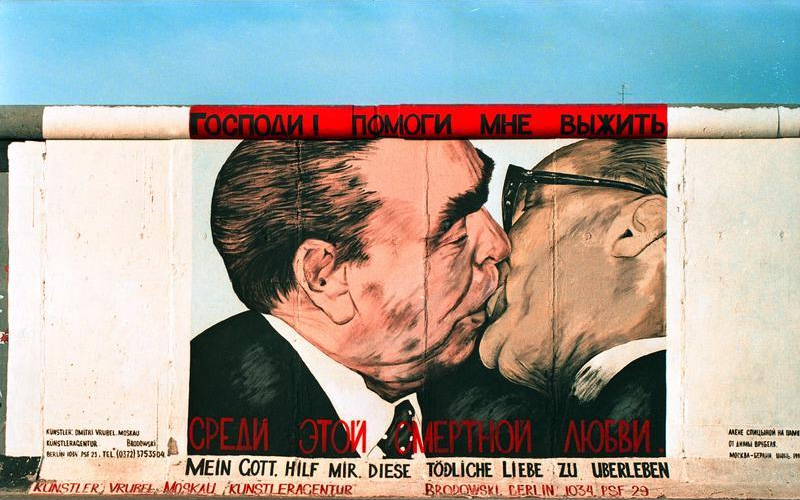
Photo Credit: https://commons.wikimedia.org/w/index.php?curid=5473698
This article was first published as part of the Sundial Press printed edition in Winter 2026
Other posts that may interest you:
Discover more from The Sundial Press
Subscribe to get the latest posts sent to your email.