

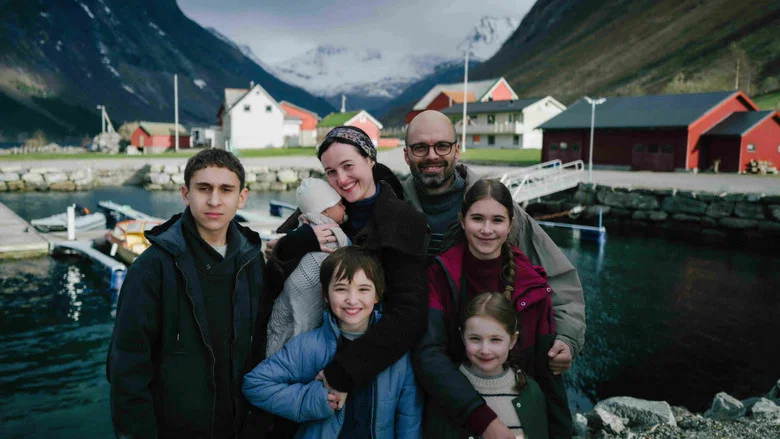
What happens when different cultural values clash within one community? People might often search for a “right” answer, an equitable solution. But which value or norm is the “right one”? The recent 2026 film release, Fjords, featuring Renate Reinsve and Sebastian Stan, exposes this core tension.
Fjords tells the firsthand story of the Gheorghiu family, who had just moved from Romania to Norway. The film highlights the family’s difficulty adjusting to life there and reveals tensions between the parents and some locals. The eldest daughter, one of their five children, is seen at school with bruises, which teachers suspect to be from her parents. In Norway, there are strict procedures and rules involving Child Protective Services when it comes to any child abuse or harm at home. The school staff is quick to file a report, as the Norwegian process requires. The children are then taken away and the family is brought to court. The family claims to have never deliberately hurt their children—spanking a child as a means of discipline was not worthy of going to jail, they claimed.
To be clear, no one in this story argues that abusing a child is acceptable; the question is whether spanking is abuse at all. For the Gheorghius, occasional spanking is a form of physical discipline, in which they themselves were raised as well. Norway, one of the first countries in Europe to outlaw all physical punishment of children, does not see a separation between the two. The film’s power lies in showing how each side can be acting in what it believes is the child’s best interest, and how a household norm that feels natural in one culture can become a crime in another. This film leaves viewers with a dilemma: to what degree can politics decide what is acceptable within the confines of one’s own home, when those norms vary from culture to culture and generation to generation?
One other example of this tension lies in baby naming rules. In France, civil registrars have the right to report a baby name if they deem it might be against the child’s interests. Iceland has an even stricter policy, where parents must pick a name from an official, preapproved list, or submit a new one for approval.
For some, naming a child is a deeply personal act, one seen as independent of government control. And yet, it is clear that policies impact personal matters, being experienced differently by different people. Such conflicts can be seen in school settings as well. For example, some education systems find it highly beneficial for students to work in groups, often structuring classes around collective projects and group assignments. By contrast, some systems might find that less collaboration would lead to more personal and accurate test scores, and would also be an easier way of tracking students’ progress.
In settings where various customs and cultures tangle, it is not surprising that reactions to policies and rules are not unanimous as well. Our campus is an example of this—students from multiple backgrounds share one school policy, on which they may or may not all agree with. Only through communication and curiosity can differences be identified and understood. In Fjords, this idea of getting to know those that differ from you played a big role. The family had one ally in town—their neighbor, a mom who they had gotten to know, was willing to hear them out and become their lawyer for their court hearing. This woman stood up for the Gheorghiu family when no one else had wanted to. Due to both families’ willingness to see past each other’s differences, they were able to build a friendship and an alliance. The film also highlights the fact that one does not have to fully agree with someone else to be able to give them a chance.
By being willing to take the time to understand others—across cultural, ideological, political and ethnic differences—different people can more easily achieve joint solutions and desires, which Fjords exemplifies. The film juxtaposes two communities with their own different values, this specific case being about the methods of educating children in one’s own private life. In doing this, the film exposes a possible weakness of communities: the lack of curiosity to learn and specifically, to learn about others.
All in all, Fjords tells a provoking story of family drama, one specifically brought about and highlighted by cultural tensions in the Gheorghiu family’s community. By exposing their reality through the influence of politics and values, the film allows for a deeper reflection about the extent to which one’s own norms interact with others. In today’s world of globalization and online sharing platforms, this analysis proves increasingly useful and will continue to be so as various norms blend and clash. And maybe, hopefully, a story like the Gheorghiu’s will help lead to a deeper understanding of the importance of each person’s culture and individuality within a united political setting.
Photo Credits: TheMovieDB
Other posts that may interest you:
Discover more from The Sundial Press
Subscribe to get the latest posts sent to your email.