

To say that we are highly influenced by the media we consume is not only a painfully obvious point, but an underestimation.
When the first season of Friends came out in 1994, Rachel Green’s layered short hair became the go-to request in beauty salons across New York. The Devil Wears Prada created an entire generation of stress-induced, productive working girls who wanted to become personal assistants. Gossip Girl encouraged thousands of teenagers to buy a diary and write long passages documenting their everyday experiences – and try to make them seem interesting.
In the 1980s, hundreds of girls switched from ballet to jazz dancing because of Flashdance, which debuted the female icon and relatable role model of the decade: a welder in a steel mill by day who, conveniently, was also extremely attractive and a phenomenal dancer.
Sex and the City told us smoking was attractive – how good did Carrie Bradshaw look holding a cigarette whilst writing her column? And, most recently, British Vogue announced the newest marker of social status and sophistication for women: being single.
The article, authored by Chante Joseph, was widely shared and discussed on social media. For many, her statement signalled an incoming generation of women who refuse to settle and a growing movement that saw men as burdens to a woman’s image. Several influencers even argued that Joseph’s article evidenced that, from now on, a woman’s value wouldn’t be determined by her “desirability” to men.
While this could be discussed for decades to come, where we would dissect the influence of red pill ideology, the polarization created by social media algorithms, the reversal of gender roles, and the overall disillusionment towards heterosexual relationships, my point here is actually focused on something else: have we considered the power of declaring something fundamentally uncool? If popular media have such an extensive influence on the way we behave, couldn’t it also be used to promote collective aims that serve the public interest?
Governments and public agencies invest millions of dollars in policy campaigns aimed at changing social behavior. Take, for instance, the Tobacco and Vapes Bill in the UK, which prohibits citizens born after 2009 from purchasing tobacco in order to discourage smoking among younger generations. The bill was highly criticized as an ineffective policy that would ultimately lead to more illegal activity without necessarily changing people’s behavior.
So, if this is the case, what measures should a government adopt to achieve its aim? Now more than ever, the success of public campaigns could lie, rather, in establishing certain habits as, as Chante Joseph called it, “loser-ish”.

Take the case of Brazil, for example, which created one of the world’s most successful anti-smoking campaigns in the last thirty years.
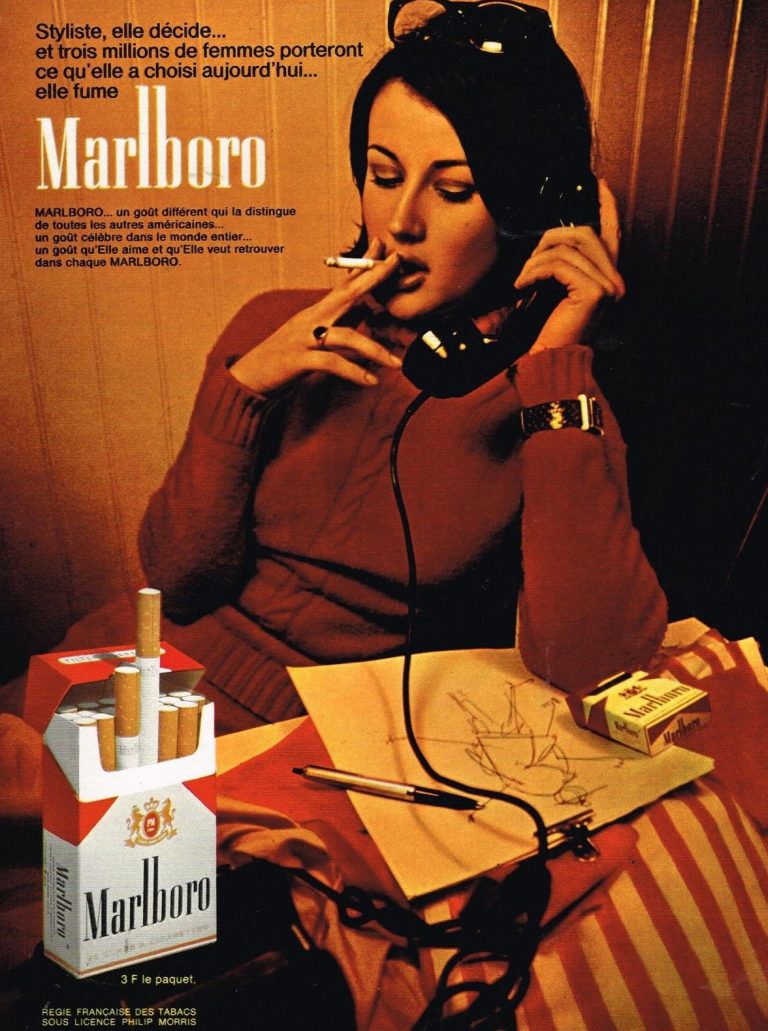
In the 1980s, smoking cigarettes was promoted as “cool” behavior. In a country-cowboy-cool-guy ad, Marlboro Man was a figure that showed smoking as “rugged and manly”, which could be seen as a symbol of rebellion or a well-deserved prize after a long day (only for the hard-working men, though).
However, after an intensive campaign that reduced tobacco
advertising, employed large off-putting pictorial labels on cigarette packs, and restricted the use of cigarettes in public places, the percentage of the smoking population in Brazil fell by over 50% in the last 26 years, from roughly 22% to 9%. Currently, cigarettes are not a luxury good that confirms someone’s position as an extremely stressed, and consequently worthy, nine-to-fiver – it just makes them smell bad and lose twenty years’ worth of lung capacity at the same time.
In France, it’s quite the opposite. The image of the ‘bon vivant,’ sitting at a round table in a café with a novel in one hand and a cigarette in the other, occasionally sipping from a glass of white wine, painted smokers as examples to replicate. Unsurprisingly, tobacco use in France has seen little change – 34.6% in 2022, down from 34.7% in 2000.
I brought the conversation to my friends, who kindly agreed to be my journalistic subjects. And while my own view on the “coolness” of public policy may not be all that relevant, it certainly makes for a good conversation starter. Let’s call them Jane and Mary.
“If I bought a new piece in H&M, I’d have to tell my friends and apologize because I would feel so ashamed,” expressed Jane, who, among other things, said that the coolest thing someone could do is to be environmentally conscious.
In her circle, which is mostly composed of German university students who identify with left-leaning ideologies, most things that demonstrate a lack of political or social awareness are also considered “uncool.” Among top contenders: driving, flying, eating meat, flaunting wealth, shopping in huge fast fashion outlets, and smoking ICOS (although rolling your own cigarettes is cool).
Mary, a student at a private business school in Western Europe, had the opposite opinion: “In a capitalist society, and to many people in my surroundings, being rich is something that makes you cooler.”
Regardless of whether their opinions towards such behaviors were fabricated by their social surroundings or if they themselves regard them as uncool, the overarching fact here is that seeing something as “uncool” ultimately deters them from engaging with those practices.
From a psychological perspective, tribalism is human nature. Human evolution occurred in the context of intense intergroup competition, in which the ones with the most loyal members were often victorious over others. The necessity, or tendency, to classify things as cool, thus, also comes from our need to identify and belong within a certain group.
Not only that, but our opinions are largely formed by the groups to which we choose to belong. Herbert Kelman, a psychologist and social ethics professor at Harvard University, theorized that compliance, or the tendency of someone to adopt a common opinion within a group hoping to “achieve a favorable reaction” or be accepted into a social network, would be one of the main forces that drives opinion formation and behavior.
We are highly influenced by the culture around us and the perceptions we hold towards certain groups of society. We trust our colleagues’ opinions and replicate them through our dressing, speech, mannerisms, and conduct. And, often, our views are also determined by portrayals of social conduct in popular media.
This is nothing new, but the novel approach that could be taken from this realization is the ability to use it in favor of public policy.
Consider climate policy and attempts to reduce carbon emissions, obesity prevention, the discouragement of fast food consumption, or bans on alcohol advertising – maybe what we are lacking here is the notion of what truly motivates people.
In current times of seven-second attention spans and a whole generation’s apparent inability to consider long-term consequences, most people don’t care about their well-being. In fact, short-term satisfaction and gratification are largely prioritized. So why not take advantage of it? Now with an even more powerful tool: social media.
Governmental campaigns on TikTok and Instagram often seem “out of place,” ironic posts that are hardly ever taken seriously by their viewers. One example is The Washington Post, one of the US’s most prominent newspapers, which has completely changed its news production approach for a young TikTok audience by making funny and simplified skits on current events. Many thought that the transition of traditional media into digital platforms would be a turning point for journalism in boosting civic engagement with the news, but it wasn’t effective. Why? Because this sort of content is not considered cool among its intended audience.
Much like popular makeup companies and luxury fashion brands, governments should be using the accessibility and virality of social media to promote public policy. Influencers now dictate what is “trendy” and “cool”, as well as what type of media to disseminate to their followers.
Governments often try to convince their citizens using facts, logic, and objective consequences, but current trends have shown a different reality – that social reputation often works faster. If a behavior becomes associated with social status, people are more likely to adopt it.
I understand the subjectivity of this statement; there is no single cool behavior for an entire culture. Whether someone thinks drinking beer or wine is cooler, prefers wearing leather over knitwear, or finds that liking rock music is a clear sign of impeccable taste depends on a variety of factors – repertoire, social standing, family, gender, sexuality, political inclination, or, most commonly, a combination of them.
In this manner, policymakers can create more effective policies by attempting to shape reputations rather than rational opinions and personal beliefs; influencing what people want to be seen as, rather than how they think.
“We thrift a lot back home because we know it’s better for the environment. People who don’t care about the planet are uncool,” said another one of my interviewees. To which I responded:
“What about smoking cigarettes? That’s also bad for the environment,” followed by a brief pause and a chuckle.
“Being a hypocrite is cool too.”
Cover Image Credit: Flashbak, 2018
In-text Image Credit : Pinterest, 2020
Other posts that may interest you:
Discover more from The Sundial Press
Subscribe to get the latest posts sent to your email.