

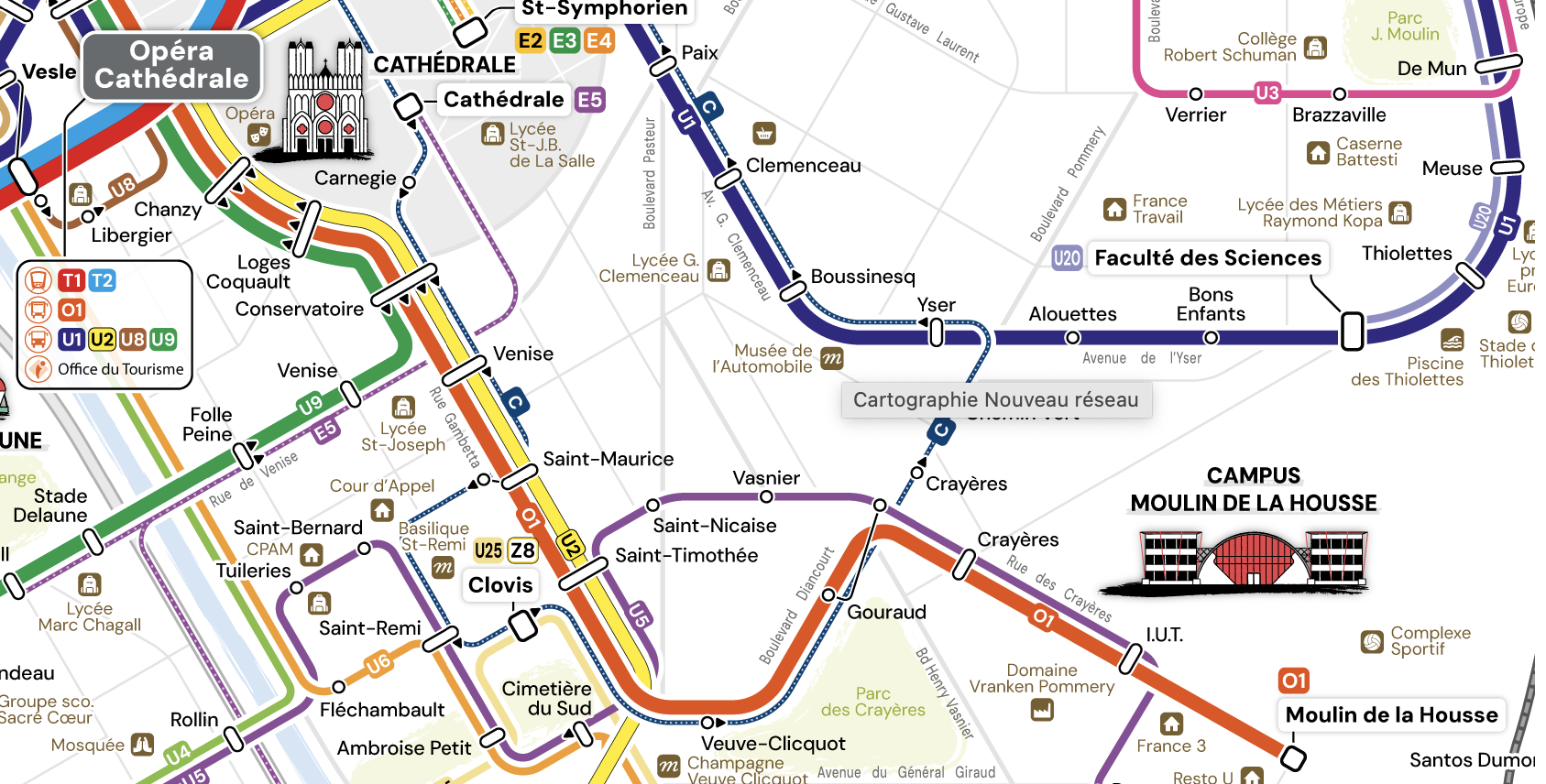
On November 24, 2025, the new O1 bus line in Reims entered service. Now, the city’s inhabitants are displeased with the changes the line represents for Reims’ public transport.
The O1, connecting Port Colbert and Moulin de la Housse, uses “bus à haut niveau de service” (BHNS) or “high level of service buses,” vehicles new to the city. The semi-bus, semi-tram transport options, as the city describes them, are 18 meters long and promise greater efficiency, transporting more people than existing buses.
This new line is part of what Grand Reims Mobilités (GRM) calls a strong framework of urban mobility. The O1 now works in tandem with the already-established T1 and T2 tram lines and the current U1, U2, and U9 lines, which are slated to become the O2 line by the end of the first half of 2026.
The O1’s implementation coincided with GRM’s new planning for older bus lines and “several improvements,” as they state about the reorganization of the city’s public transport system.
GRM has made many proclamations about the expected success of the new network. Purportedly, the U8 bus connects the center of Reims to the neighboring Thillois “without interruption.” Additionally, the Coubertin Middle School and the Michelet Stadium were said to be largely accessible through the “regular” U21.
In a report released in November 2025, Reims Mayor Arnaud Robinet said all of these changes are a “step forward” for the city. Overall, the city leadership discourse treats the matter as a highly positive direction for Reims. When public leaders of administrative systems speak so highly of such developments, it is critical to look at what the urbanites themselves think.
Users of the bus system are very displeased with the changes. A festering Reddit chat under r/Reims has an array of negative comments to make. User BubblyHive writes, “Thank you to the city of Reims. After all this construction, getting around in Reims, which was already a nightmare, is even worse.” They continue on to write that the large sums of taxpayer money the city spent on the new public transit system only make the city more “unliveable.”
It was reported in the 25th edition of the Grand Reims Winter Magazine that a budget of 11.5 million euros was promised for the Voie des Sacres project overall in 2025. This large-scale urban beautification project will, upon its termination, redo much of the route along which the O1 line runs. Including new bus stops, more green spaces along the road, and the main street reserved for the BHNSs, this budget would not seem excessive if forthcoming improvements were genuinely beneficial. An additional 3.6 million euros was used for the BHNS implementation in 2025.
User MostPay9617 continues the discussion with “I was used to the old system, which seemed clearer.” To use a common expression, if it ain’t broke, don’t fix it. While the city deemed the system in need of fixing, the users’ negative opinions pose questions about if citizen participation was used in the new planning framework.
While these users are anonymous under Reddit’s guidelines, a local Reims student has been willing to speak on his experiences. With 36,000 students in the Grand Reims region, one in six people in the city’s about 200,000 population is in a student’s general position of limited personal mobility and may rely on public transport.
“Phantom buses are still a big issue for me,” says Dylan, 19, a student at Sciences Po Paris, Campus of Reims. “The timetables are just a terrible reference because they are never on time, especially when you get later into the evening.” He was a regular user of the original bus system and still needs to bus weekly for his internship across the city.
While we are in the early stages of this large-scale project and some mishaps are unavoidable, such a prolonged period of recurring logistical issues poses a significant challenge for the Remois.
The Grand Reims Magazine also provided an interview with Mayor Robinet in which he states, “We come to Reims to study.” His words suggest the urban center is diverse in social groups but also points to the disappointment the new system has been so far. Every inhabitant of the city deserves reliable means of transportation.
It is only by combining public and private opinions that we can understand the true functionality of public transportation. These systems are not just plans on paper. The city cited “prestige” as the expected outcome of the changes, but expectations are void when they do not meet the needs of those looking forward to them.
With rolling improvements on the O1 line and the up-and-coming O2 line to come by the end of 2026, we can wonder what the inhabitants of Reims will continue to think in the meantime.
Photo credit: Grand Reims Mobilités “Nouveau Réseau” transportation map, February 2026.
Other posts that may interest you:
Discover more from The Sundial Press
Subscribe to get the latest posts sent to your email.