
The European Union has repeatedly condemned and even sanctioned Afghanistan’s ruling Taliban, which has failed to secure formal recognition by the United Nations not least in view of its restrictions on human rights and the systemic oppression of women and girls.
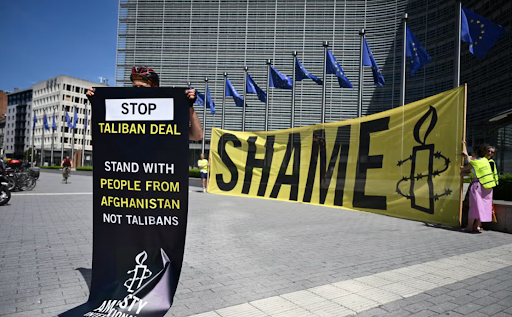
And yet, in June 2026, 15 Member States along with officials of the European Commission reportedly met with Taliban representatives in Brussels. Officially, the meeting’s focus was increasing the efficiency of deportation of irregular or criminal migrants from the EU to Afghanistan. Few details have been released about the discussions, but the New York Times reported that mentions of human rights abuses were notably absent from the conversation, which apparently solely focused on ‘technical details of expulsions’. The meeting sparked controversy and scrutiny about both motives and consequences:
What are the drivers behind this change of diplomatic course, and what are the risks of EU engagement with one of the world’s most radical regimes?
At a time when European Member States are witnessing a surge in support for far-right movements, a marked increase in the drive to deport Afghans is observable, with key member states such as Germany at the forefront. Germany is currently under a centre-right government which faces increasing internal threats to its power from a radical far right party, the Alternative für Deutschland (AfD), that managed to secure critical election gains and has taken the lead in national polls. Chancellor Friedrich Merz aims to be seen as intransigent on migration to counter the AfD surge and to (re)capture voters on the far right. Afghans represent a fifth of all German asylum seekers, however the vast majority have legal status. According to the New York Times, Germany has not only deported 263 Afghans over the past 18 months, but has also begun to deport individuals without criminal records and in complete disregard of the human rights record of the country to which they are being sent and thus also in complete disregard of their refugee status.
This phenomenon is not unique to Germany. As aforementioned, this trend in populist movements and the subsequent reaction is also visible in other European countries. The recent questioning of the government over the low number of Afghan deportations from France by Bénédicte Auzanot, an MP for the far-right Rassemblement National (RN), illustrates how these populist parties, which place stricter immigration controls and increased deportation at the centre of their manifesto, put pressure on established political parties to implement tougher stances on immigration. As evidence, on October 8th 2026, the spokesperson for the French Ministry for Europe and Foreign Affairs confirmed that Paris had initiated technical conversations with the Taliban in order to better facilitate the deportation of Afghan nationals who were considered “national-security threats”, despite maintaining its refusal to recognise the regime.
France’s reaction demonstrates how the extent of electoral influence of far-right parties not only impacts domestic politics but also transcends beyond that into foreign policy decisions. This leads to France continuing discussions with regimes it publicly condemns ,therefore giving the Taliban more leverage.
What are the risks of EU countries engaging directly with the Taliban?
Though one could argue that recognition and legitimation are two separate things, it is undeniable that the negotiations are threatening to normalise the Taliban regime – a concern echoed by human rights groups such as Human Rights Watch and Amnesty International. By hosting the Taliban officials in Brussels, European governments risk strengthening the Taliban’s standing as an international political actor. This legitimisation encourages broader international acceptance of the regime, despite their human rights violations, especially on women’s rights. This, the New York Times argues, fulfils the motivations of the Taliban, whose aim for more legitimisation is evidenced by their additional requests for increased access to diplomatic discussions and economic assistance.
By running the risk of normalising and thus strengthening an illegitimate and oppressive regime, the EU not only contradicts international principles but undermines – and weakens- its own organisational integrity.
The EU’s founding principles are those of a European Union of Values, with the protection of human rights and international law at its very core. Article 2 of the Treaty on European Union (TEU) places human dignity, democracy, equality, rule of law and human rights at the centre of the union’s foundation. Article 21 establishes that the EU’s international actions should be guided by these values.
Yet, the EU converses with actors who have been proven to go against those fundamental values. Furthermore, Human Rights Watch has posited that the returning of Afghans to the Taliban regime risks exposing them to inhumane persecution, such as arbitrary detention, torture.
So why would the EU undermine these very principles, which are foundational to the union?
The answer: a need for power preservation which entails bending to the public pressure for stricter deportations.
Yet, every act that is in breach of the EU’s founding principles not only weakens international norms, but also puts the legitimacy of the EU itself into question. It seems counterintuitive that at the very time European states struggle with movements that are openly challenging democracy, equality, rule of law, human rights, and indeed the value of the EU itself, governments risk to undermine its very reason ‘d’être’ – to be.
Picture: Nicolas Tucat/AFP via Getty Images
Other posts that may interest you:
Discover more from The Sundial Press
Subscribe to get the latest posts sent to your email.