

From October 6 at 09:00 to October 8 at 17:00, Sciences Po students will vote for representatives on four councils. Of these four, two concern undergraduates: the Institute Council (Conseil de l’Institut) and the Student Life and Education Council (Conseil de la vie étudiante et de la formation).
The Conseil de l’Institut (CI) is charged with the general administration of education and research at Sciences Po. It is composed of 31 members, of whom eight are elected students. The Conseil de la vie étudiante et de la formation (CVEF) is responsible for matters concerning student life and discipline, and plays an advisory role on pedagogical matters. It is composed of 18 members, of whom eight are, again, elected students.
Elections to both bodies are conducted by proportional representation. For the Collège D, where undergraduate students can vote, there are seven lists running for the CI and five lists for the CVEF. Students will be able to vote through LegaVote using the password sent in the e-mail titled “Sciences Po – Elections 2026 aux instances de l’IEP de Paris et au conseil de l’école doctorale.”
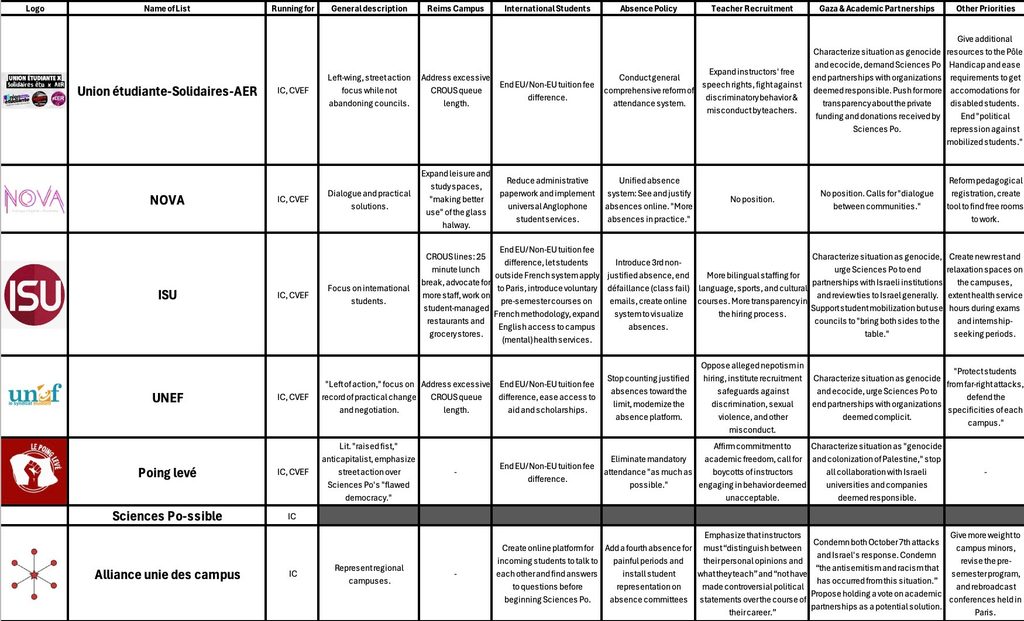
To help Reims campus students decide whom to vote for, we analyzed all available platform statements and asked all lists questions concerning salient issues. Below is a summary of what each list stands for, in the order assigned to them by the Electoral Consultative Committee.
Union Étudiante – Solidaires – AER Joint List
Three left-wing student unions, Union Étudiante Sciences Po, Solidaires, and Alternative Étudiante Rémoise, are running together for both councils. Describing themselves as part of the “anti-fascist youth,” they strive to make Sciences Po “an inclusive, anti-racist, feminist, democratic, and truly public university.” While not abandoning council work, they emphasize the importance of street action, and lament what they view as too low a proportion of seats reserved for students on the CI and CVEF.
On International Students:
The joint list advocates for an end to higher tuition fees for non-EU students.
On Absence Policy:
The joint list is in favor of a general reform of the attendance system, and, while this is not its official position, some unions within the list favor the total abolition of mandatory attendance.
On Teacher Recruitment:
The joint list affirms its support for academic freedom and the expansion of free speech rights for instructors, while clarifying that discriminatory behavior and other misconduct are not acceptable.
On Gaza and Partnerships:
The joint list classifies the events in Gaza as a genocide and ecocide, and demands that Sciences Po end all partnerships with organizations deemed responsible. It also pushes for more transparency about the private funding and donations received by Sciences Po.
Other Priorities:
The joint list makes accessibility a major plank of its campaign, supporting more transparency and resources for the Pôle Handicap, and an easing of requirements to get accommodations. The unions also wish to end what they view as the “political repression against mobilized students.”
NOVA
The NOVA student union is putting up candidates for both councils. It takes aim at previous student representatives for “endless confrontations and controversies,” and emphasizes its support for dialogue and practical solutions.
On International Students:
NOVA wishes to reduce the burden of administrative paperwork and establish permanent Anglophone Student Services Centers on all campuses. On integration, it cites the Reims campus as a model, and says its success ought to be replicated on other campuses.
On Absence Policy:
NOVA supports “a more flexible and realistic absence policy,” and draws attention to its vote in favor of an additional day of menstrual leave, a policy that took effect this year. While the union clarifies that it doesn’t support a total abolition of mandatory attendance, its lead candidate signals that NOVA’s unified absence system proposal, which would let students see and justify their absences online, would, in practice, lead to an expansion of absence rights.
On Teacher Recruitment:
When asked, NOVA did not take a position on teacher recruitment, pointing out that students had no direct influence over it.
On Gaza and Partnerships:
When asked, NOVA did not take a position on Gaza or Sciences Po’s academic partnerships, calling for continued “dialogue between communities.”
Other Priorities:
NOVA backs reforming pedagogical registrations, creating a tool to help students find free rooms to work, and informing more students about Sciences Po’s equal opportunity program (CEP). For the Reims campus specifically, the union would like to expand leisure and study spaces, and “make better use” of the glass hallway.
International Student Union
The ISU is putting up candidates for both councils. In its manifesto, it laments that student life at Sciences Po often does not reflect the fact that half of its students come from abroad, and promises bilingual inclusivity, student democracy, academic equality, more access to aid opportunities and health services, and career help.
On International Students:
The ISU is in favor of an end to the EU/non-EU distinction in tuition fees and a reversal of the decision barring international students from applying to the Paris campus. It is a proponent of increasing the number of available bilingual staff, especially during exams, and introducing voluntary courses on French methodology in the pre-semester period to help those not accustomed to it adapt. The ISU also notes that international students are often those most in need of the expanded mental health resources they advocate for (detailed in Other Priorities).
On Absence Policy:
The ISU would like to see an end to the “défaillant” (failed) emails, an online portal for students to visualize their absences, and an introduction of a third unjustified absence.
On Teacher Recruitment:
The ISU advocates for more bilingual instruction, especially for language, sports, and cultural courses, as well as more transparency with respect to the hiring process. The union emphasizes that recruitment must reflect the principles of “equality and inclusion.”
On Gaza and Partnerships:
The ISU condemns what it characterizes as a genocide in Gaza and urges Sciences Po to end its partnerships with Israeli institutions and to review its ties to the State of Israel. The ISU also stresses that while it supports student mobilization, elected bodies such as the councils and other institutional channels should be used to “bring both sides to the table.”
Other Priorities:
On mental health and stress, the ISU presses for the expansion of English access in campus health services and the creation of new rest and relaxation spaces on the campuses. It also highlights its proposal to extend health service hours during exam and internship-seeking periods, and touts the union’s successful CVEF campaign to select mental health as the annual theme for next year’s collective budget.
With regard to the Reims campus, the ISU underlines the problem of long lines in the CROUS cafeteria. It seeks to institute a 25-minute break from classes during lunch hours, push for more staffing, and start a working group on student-managed restaurants and grocery stores with healthy food options, such as Paris’s PAVéS.
Union Nationale des Étudiants de France
The UNEF, which is running for both councils under the slogan “One foot in the council, the other on the street,” pitches itself as the “left of action.” It strives to distinguish itself from other left-wing lists by focusing on a record of practical change and negotiation with the administration.
On International Students:
The UNEF wants the EU/non-EU distinction in tuition fees scrapped, as well as easier access to financial aid and scholarships.
On Absence Policy:
The UNEF proposes that justified absences no longer count as absences, that the absence platform be modernized, and that its student employee status proposal be adopted and eventually expanded to student careers. These recommendations were produced, the union highlights, in an intercouncil working group they contributed significantly to. The union calls for a vote on them as soon as possible.
On Teacher Recruitment:
The UNEF affirms its support for the diversity and independence of the teaching body and academic freedom in general. It vows to oppose nepotism in recruitment and undue influence on teaching content by the administration. The UNEF also advocates for safeguards against hiring people with a history of discriminatory behavior, sexual violence, and other misconduct.
On Gaza and Partnerships:
The UNEF defines the situation in Gaza as a genocide and ecocide, and supports ending Sciences Po’s partnerships with organizations deemed complicit. More generally, it demands transparency with regard to the donations received by Sciences Po.
Other Priorities:
The UNEF aims to “protect students from far right attacks,” increase access to “good food,” and defend the “specificities of each campus.” For the Reims campus in particular, it points to the excessive length of the CROUS cafeteria line as a problem it would like to address.
Le Poing Levé
Left-wing Le Poing Levé (lit. “raised fist”) is running for both councils. Its members position themselves as anti-capitalists fighting against the “far right, militarization, and the genocide in Gaza.” Regarding the Sciences Po councils as a “flawed democracy” in “the hands of the administration,” they emphasize street action while maintaining that student elections do provide some leverage against the administration. Le Poing Levé is affiliated with the Trotskyist political party Révolution permanente.
On International Students:
Le Poing Levé is against the EU/non-EU tuition fee difference, and wishes to connect its opposition to the policy with other universities, where similar schemes are being implemented.
On Absence Policy:
Le Poing Levé views mandatory attendance as a tool of control used by the administration and supports its elimination “as much as possible.”
On Teacher Recruitment:
Le Poing Levé opposes approaches to research that focus on military/hard power. It supports better treatment of adjunct instructors. While affirming its commitment to academic freedom, Le Poing Levé calls for boycotts of instructors engaging in behavior it deems unacceptable.
On Gaza and Partnerships:
To combat what it defines as the “genocide and colonization of Palestine,” Le Poing Levé believes Sciences Po should stop all collaboration with Israeli universities, as well as with all companies deemed directly or indirectly responsible.
Sciences Po-ssible
The Sciences Po-ssible list, running for the Conseil de l’Institut, has neither uploaded an official program statement nor responded to our written questions as of this article’s publication.
Alliance Unie des Campus
The AUC (lit. United Alliance of Campuses) is, as its name implies, a list concerned primarily with representing the regional campuses of Sciences Po. It is running only for the Conseil de l’Institut.
On International Students:
The AUC proposes an online platform where new students would be able to register before the semester starts and talk to each other to find answers to questions about Sciences Po.
On Absence Policy:
The AUC finds the current absence policy generally fair but supports a fourth justified absence for menstrual pain and student representation on the committees that decide whether students are marked “défaillant” (failed) because of absences.
On Teacher Recruitment:
The AUC affirms its commitment to academic freedom, but notes that instructors must “distinguish between their personal opinions and what they teach” and “not have made controversial political statements over the course of their career.”
On Gaza and Partnerships:
The AUC condemns both the October 7th attacks and Israel’s response, which it describes as disproportionate. It also condemns “the antisemitism and racism that has occurred from this situation.” With regard to academic partnerships, it supports a case-by-case analysis and suggests that a popular vote on the issue might be a suitable solution.
Other Priorities:
The AUC would like to give more weight to the academic minors of each campus, revise the pre-semester program, and rebroadcast conferences held in Paris.
Photo Credits: AuFutur
Other posts that may interest you:
Discover more from The Sundial Press
Subscribe to get the latest posts sent to your email.