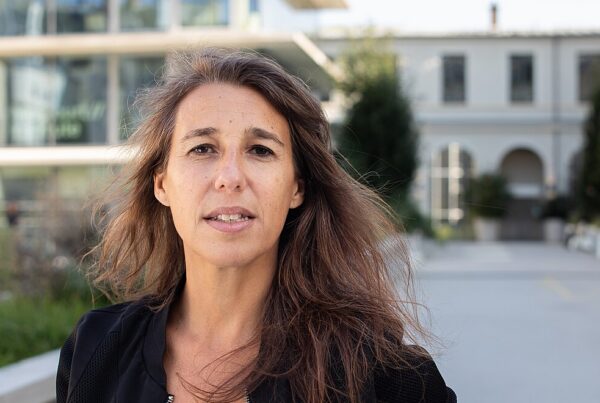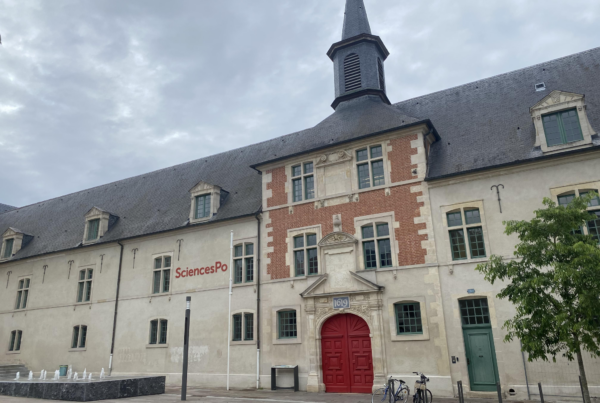

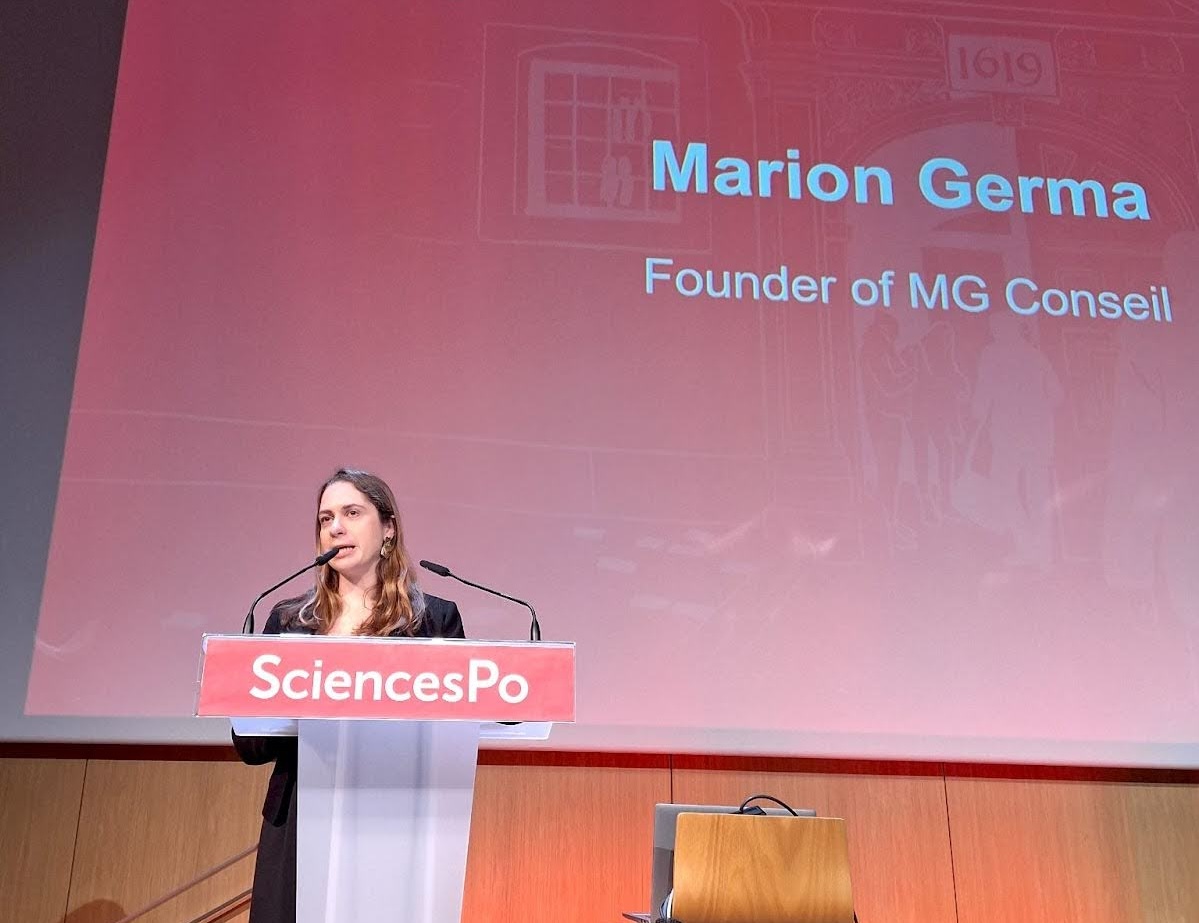
On Friday afternoon, January 23, all first-year students gathered in the LS01 amphitheater to attend the Civic Engagement Day. The event was organized by the Civic Learning team to present the parcours civique. This year, non-French-speaking students were able to follow the presentation thanks to real-time subtitles displayed on screens, in an effort from Lorraine de Belenet and Eléonore Leïva to respond to last year’s feedback and adapt to the international audience. This year’s edition was inaugurated by a lecture delivered by an inspiring figure who shared her journey through the thematic prism of her commitment to worthwhile causes: Marion Germa.
Marion Germa teaches a class on AI on the Sciences Po Paris campus and founded MG Conseil, a counseling cabinet promoting the democratization of financial education and AI training. Some may have recognized her from the online masterclass she gave in October 2025 to help students manage their budget. As a recent Sciences Po graduate, she has used her studies as a springboard for shaking up social barriers. What better Grand Témoin than her to understand the student experience and provide meaningful advice?
Marion Germa grew up in a village near Grenoble. Passionate about Harry Potter, music, Greek mythology, and politics, she had never heard of Sciences Po, and when she later came across the school’s website by chance, she instantly figured that it was meant for her. Warned by her parents that they wouldn’t have a cent to spend on a private preparatory school, she prepared and passed the entrance exam on her own. In September 2012, starting her Bachelor’s on the Paris campus, she faced a cultural shock and became insecure about her purported lack of money, network, and a showy resume as compared to her fellow students. Being daring and getting out of her comfort zone was key to gaining confidence.
In her speech, she remembered that the French Ministry of Europe and Foreign Affairs had once organized a reception with former Minister of Justice Robert Badinter, where 100 randomly drawn Sciences Po students would be invited. She took it upon herself to call the Quai d’Orsay to try to sneak into the guest list by explaining her motivation to attend. And she succeeded. Ironically, she later found out that she was part of the randomly drawn students. So she was lucky—but she didn’t count on it. This dauntless move serving her thirst for discovery sets the tone of her commitment to breaking barriers.
As she began to fit in, she kept in mind the struggles she experienced at the beginning. Out of these, she created a free website to help students get into Sciences Po—especially those with less door-opening experiences and financial means: SOS Sciences Po. This confession sparked whispers of surprise and admiration amongst students, many of them having benefitted from this tool which pairs applicants to current Sciences Po students, the latter advising them for the entrance exams. For this achievement, she was awarded the Prix Aulagnon-Bettan, which rewards first-year Bachelor’s students displaying an excellent academic record and outstanding commitment to promoting social inclusion. However, she faced criticism from her cohort, with students denouncing a threat on Sciences Po’s meritocratic and elitist model. Staying true to her commitment to free access to information, she declined many offers from private preparatory schools and publishing houses willing to buy her concept.
Upon graduating from Sciences Po’s Master in Public Policy, she became a parliamentary collaborator for former French Minister Benoît Hamon. After this experience, where she pointed out that she had “never felt so useful,” she worked as a project manager for International Business Machines Corporation and various start-ups. She found these experiences intellectually stimulating yet lacking depth and connection to the causes close to her heart. Thus, two years ago, she made the daunting decision to quit her job in order to launch her own firm, MG Conseil, to strive for equal access to information and opportunities in wealth management.
Throughout her testimony, Germa incentivized students to dare to commit themselves to a cause: “If you feel like you have something to bring, don’t hold back because it will necessarily be useful to someone.” To her, there is no better place than Sciences Po to initiate your own path of engagement. She encouraged students to take pride in giving a little help to people’s trajectories instead of minimizing our impact, and to embrace fluctuations in our commitment across time, because, as her journey shows it, the causes that matter most to us will resurface and a window of opportunity to engage will appear.
To her, civic engagement comes down to dedicating to a cause and to people, to putting names and personal stories on abstract concepts. She shared that when she entered Sciences Po, she had grown tired of German and decided to learn French sign language, which opened her to an unexpected new universe of commitment. This is what the Parcours Civique entails: unveiling new horizons of humanity and understanding, dedicating oneself to a meaningful cause as a citizen, and perhaps discovering a new passion. To be honest, I am somewhat envying 1As for having yet to discover all of this…
Photo credits: Eléonore Leïva
Other posts that may interest you:
- Réjane Sénac’s Plea for Animal Rights
- The challenges of contemporary opera: Insights from Alexander Neef and Aude Accary-Bonnery
- US Foreign Policy under President Trump’s Second Term in Eight Key Words
- Habemus Papam: What Consequences for International Relations?
- Biased Narratives And Independence Dilemmas: What Perspectives For Greenland?
Discover more from The Sundial Press
Subscribe to get the latest posts sent to your email.