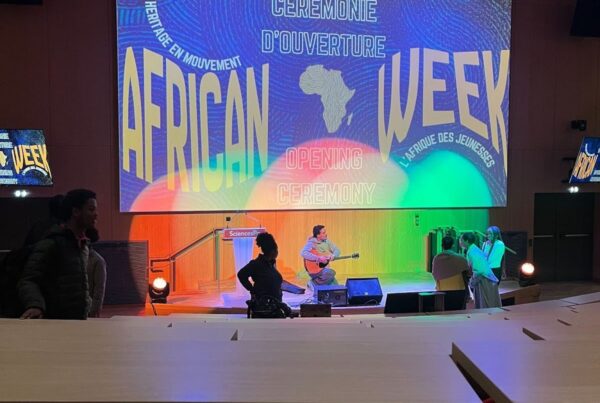

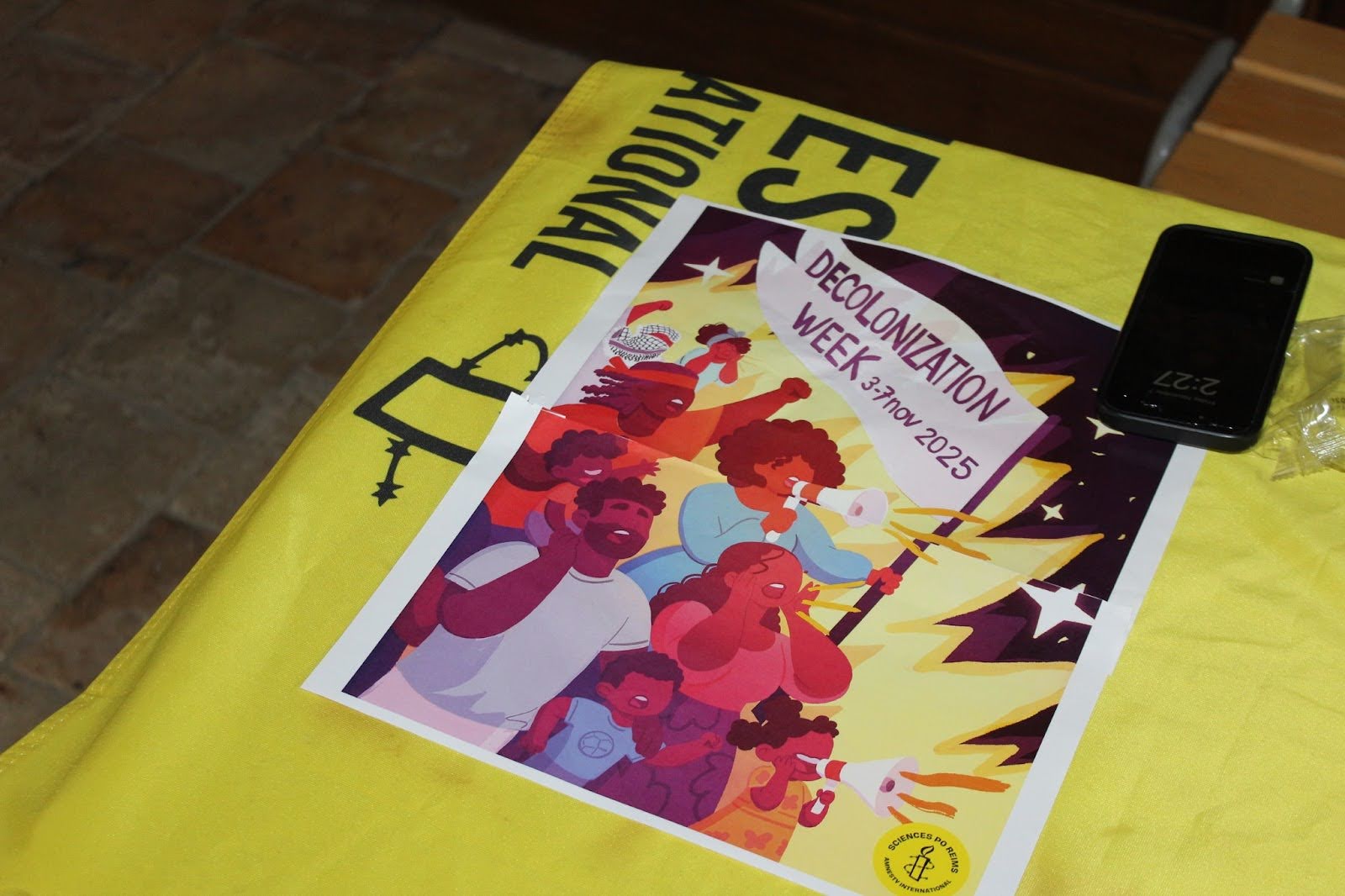
As the seats of D101 filled up on the afternoon of Monday, November 3, an executive member of RIMUN posed the question, “What is decolonization?” Speakers around the room stood up, beginning a brief poetic performance discussing decolonization worldwide. Some touched upon the process and corrosive impacts of colonization, while others mentioned the importance of bringing awareness to it. The theatrical introduction ended with a collective chant: “Together, let’s fight for, celebrate, and claim decolonization!”
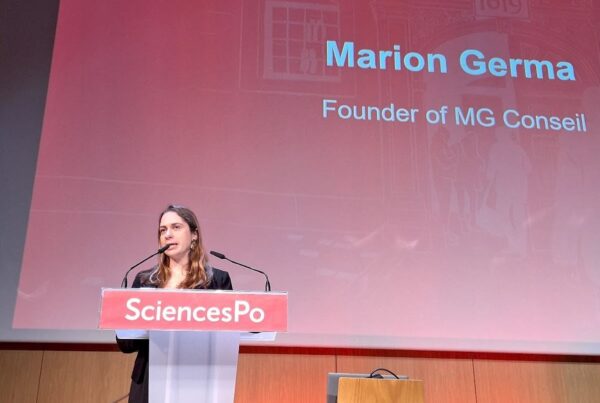
Amnesty’s Sciences Po Reims Chapter Co-Presidents Ruofei Lu and Sarah Berger then officially welcomed the audience by discussing the significance and modern meaning of colonialism. Lu further stated that “the goal of Decolonization Week is to remember, to reflect, and to act for freedom of movement, self-determination, and dignity.”
Following this, attendees watched a brief recorded address from South African human rights activist and former Amnesty International Secretary General Kumi Naidoo. He outlined core principles for escaping the inequalities imposed by colonial legacies: acknowledgement by colonial powers of their actions, reparations and responsibility, mutual learning, and youth leadership. He also pointed out that movements often use the language and messaging of university-educated elite, making it inaccessible and unappealing to the broader population. His address finished with a call to action: “You are not the leaders of tomorrow … you have to understand that you have to be leaders today.”
An introductory conference was then led by French social scientist and professor Olivier Esteves on his recently released book (available in both English and French), La France, tu l’aimes mais tu la quittes : Enquête sur la diaspora française musulmane (France, you love it but leave it: The silent flight of French Muslims). Co-written with social science researchers Julien Talpin and Alice Picard, the study seeks to uncover the reasons behind the mass emigration of French Muslims in recent decades using a combination of interviews and questionnaires.
Esteves and his co-authors found this trend was primarily motivated by a desire to avoid discrimination and find a more peaceful religious environment. The subjects cited France’s obsession with hijabs, the lack of prayer rooms, discrimination by state agents, and workplace discrimination as causes for their departure. Esteves contends that this problem is fundamentally a post-colonial one, arguing that it derives from France’s colonial history with Algeria. He stated that Muslim women believed themselves to be seen as “traitors” to the Fifth Republic because of their hijabs, arguing that French “catho-laïcité” regards Catholicism and its values as a part of everyday life, while Islam and other religions are seen as counter to French culture.
Besides this, Amnesty maintained lively engagement throughout the rest of the week. Amnesty’s Pole Media shared student-written exhibitions covering decolonization in the Salle des Actes in collaboration with other associations. ASPA, ALAS, AIRA, Sciences Ô, and SJP shared articles about the meaning of decolonization in their respective regions, while TFS, Politiqu’elles, and SAGA wrote about decolonizing ideas of gender and sexuality. Members of Pole Media itself also wrote a larger article about the meaning and significance of decolonization. Pole member Juliana Wang mentioned being proud of the joint work behind the exhibit: “We were able to show a really meaningful solidarity between different groups of people affected by colonization … it feels like [the other associations] gave us all the pieces and we were able to put it together into a tapestry of decolonization.”
Two movie screenings were also held. In collaboration with ASPA, Amnesty screened the 2025 film Muganga, celui qui soigne, inspired by Denis Mukwege and Guy-Bernard Cadiere’s book Panzi, covering two doctors’ description oftheir work with victims of sexual violence in the Democratic Republic of the Congo. With TFS, attendees watched the documentary Bye Bye Tiberias, chronicling the journey of a woman returning to her Palestinian homeland with her daughter after having left during her youth.
On Thursday night, Amnesty co-hosted a “Party on an 808 for Palestine” with Soundsystem, Le Seize, and SJP designed to fundraise for Résilience Gaza, an organization that provides food, medicine, education, and other aid to Palestinians. Lu mentioned it was a big success, raising over €300 through ticket and merchandise sales. Student engagement was also significant, with one event staffer celebrating, “It is great to see so many people passionate about such an important cause.”
On Tuesday and Thursday, the association also held two debate workshops in collaboration with RIMUN, raising motions on the return of cultural artifacts and issues related to national sovereignty.
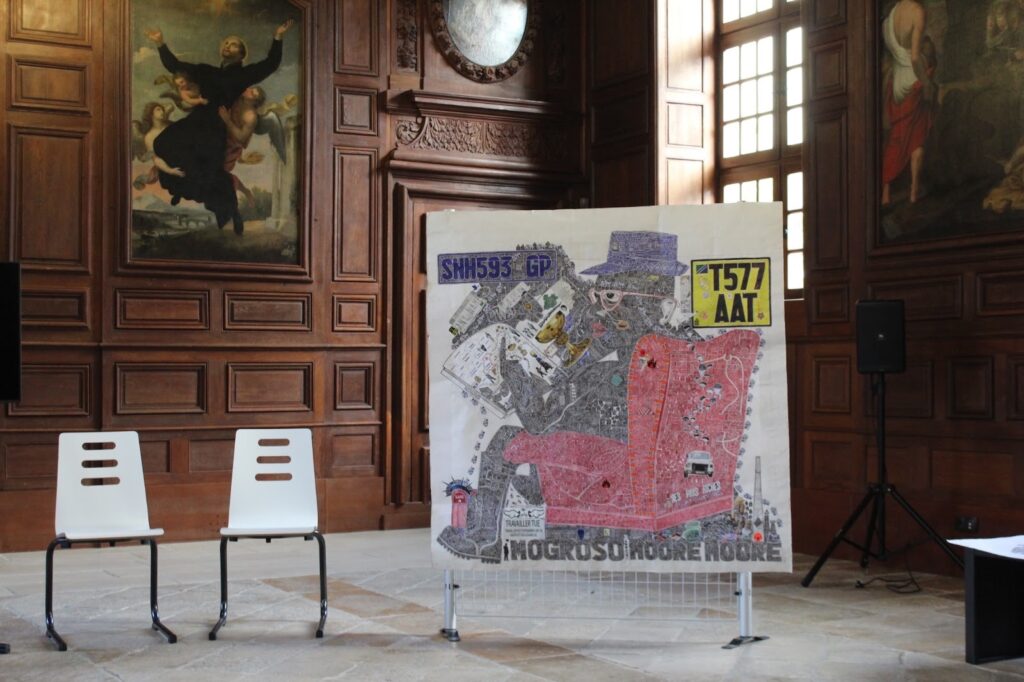
To conclude the week, Amnesty and ASPA hosted an interactive conference featuring Méga Mingiédi, a Congolese artist. He brought three works of art in the style of maps, which he used to illustrate the lasting impacts of colonialism and imperialism.
While themed week-long campaigns are a long-running annual tradition on our campus, this was the first year that Amnesty held Decolonization Week. Lu discussed some of the motivation for it: “What I think was lacking [on] this campus … is something that’s political, something that makes people think more. … [Our program] talks about the history of [colonialism], but it doesn’t talk about the implications of it. It doesn’t talk about the political reality of it. It doesn’t talk about the contemporary type of colonization that’s happening right now. … That’s why we have [Decolonization Week].” Pole Events member Elena Martin Ortega shared similar sentiments over its relevance: “[it] needed to be talked about on campus. … [Colonization] is such a long, deep-rooted, embedded, systemic problem in so many different societies.”
Lu expressed frustration with the attitude of students on campus towards involvement in activism and politics.
“We are so privileged in being in this institution, so privileged in having the ability to do this week, having the ability to speak out against injustices and empires and authoritarian governments. At the same time, we have to act. We have to do something in our capacity, try our best to do whatever we feel is appropriate. … [At] Sciences Po, many people think they have a lot to lose, many people think they’re in a very high-stakes situation. I disagree to some extent. I think when it comes to social movements, everyone should participate no matter their class. … We should all try harder, [have] more courage, and sacrifice more … for a world with equality and justice.”
Cover Image Credit: Emma Weibel
Other posts that may interest you:
Discover more from The Sundial Press
Subscribe to get the latest posts sent to your email.