
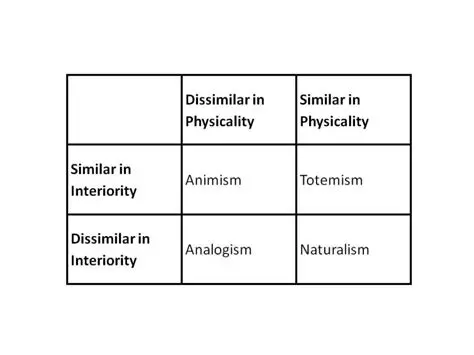
“We are nature defending itself!” claim environmentalists across the world. The message of this punchline is clear: humans belong to nature. But who started seeing humans as distinct from nature? I recently watched an interview with Philippe Descola, author of Beyond Nature and Culture (2005)and a famous anthropologist who drew the “4 Ontologies” of Nature according to his ethnographies among Amazonian First Nations.
To sum up, in most civilisations across the world, including in Western culture, the view people have of the world comes from the dualist mindset. According to this ontology, we are all made of physical, tangible, and palpable matter. But we humans also have a soul, a spirit, which confers us dignity and empathy. According to a 2023 study, 83% of all American adults believe people have a soul or spirit in addition to their physical body. 83% of Americans are dualists.
Descola’s research invites us to see the bigger picture. To take a step back from 15 000 years of naturalism. What is naturalism? It is a vision of the world encompassed into dualism. Naturalism states that bodies are divided into two groups. And what draws the frontier between the two groups is the soul. Us, humans, have a spirit, unlike the other living species, the rocks or the rivers. So, humans and nature are different regarding the spiritual side, but are similar when it comes to matter: we are indeed made of the same atoms, the same 118 elements. On the contrary, some cultures, including those studied by Descola in South America developed an animist vision of the world: humans and nature are different when it comes to the physical side: the rock is hard while the human skin is soft, and a fish deep in the ocean has no chance of evolving in the same physical environment as an eagle in the mountains. But there is a spiritual continuity: a human can dream of being a fish at night, for example. In addition to naturalism and animism, 2 other conceptions state either two continuities, totemism, or two discontinuities, analogism.
15 millennia of naturalist impregnation.
Most of us almost never put into question naturalist ontology. It is probably the vision most agrarian civilizations have adopted since the birth of agriculture 15,000 years ago. This scheme impregnates all parts of our life. It shapes the way we speak: “he,” or “she,” has a soul, but “it” doesn’t. This ontology also shapes the way we rule: Western laws are based on a division between peoples and goods; the first are endowed with a juridical soul, whereas the second isn’t. For example, this division allowed the Christian Church to discriminate against non-Christians with the concept of “limpieza de sangre” (blood purity) starting in the XVIth century, stating that Christians have a soul, others don’t. This rule, first set in Toledo in 1449, opened the way for considering Jewish populations, then Black populations, or People from colonized countries as “savages,” meaning belonging to nature and therefore without souls.
Naturalist laws adopted a new turn in the XVIIth century: Dutch and British East India Companies became the first limited companies. This is a striking landmark in the birth of capitalism. For the first time, the ships carrying merchandise were not owned by a person, but by a company, which became “juridical persons”. Today, companies and States have “interests,” sometimes they “need help,” to sum up, they have a soul.
The human/nature dichotomy: the roots of dominations over ecosystems
As you’ve now become an expert of soul distribution, you may have noticed a certain inconsistency: the American flag is endowed with the great soul of the most powerful country of the world, while the cotton plant that produced the fabric isn’t endowed with anything.
This is the reason why being aware of this naturalist ontology is necessary. It is this view of the world that first allowed trade, then capitalism, and today the critical depletion of ecosystems.
Trading fish in exchange for wood planks is only possible if you state that there is a physical continuity between fish and wood. Then, accumulating capital made of “natural resources” is only morally acceptable if this nature doesn’t have a soul, while humans do, giving “he” or “she” the legitimacy to look for comfort and consumption.
At the end of the interview, Philippe Descola concluded with what can resonate as a challenge for young generations of students committed to building a better society: “the current situation would require enormous intellectual efforts to imagine institutions beyond the naturalist view”.
Thus, this is the final issue: will we be up to the task?
Photo Credit: Radio-Canada
Other posts that may interest you:
Discover more from The Sundial Press
Subscribe to get the latest posts sent to your email.