

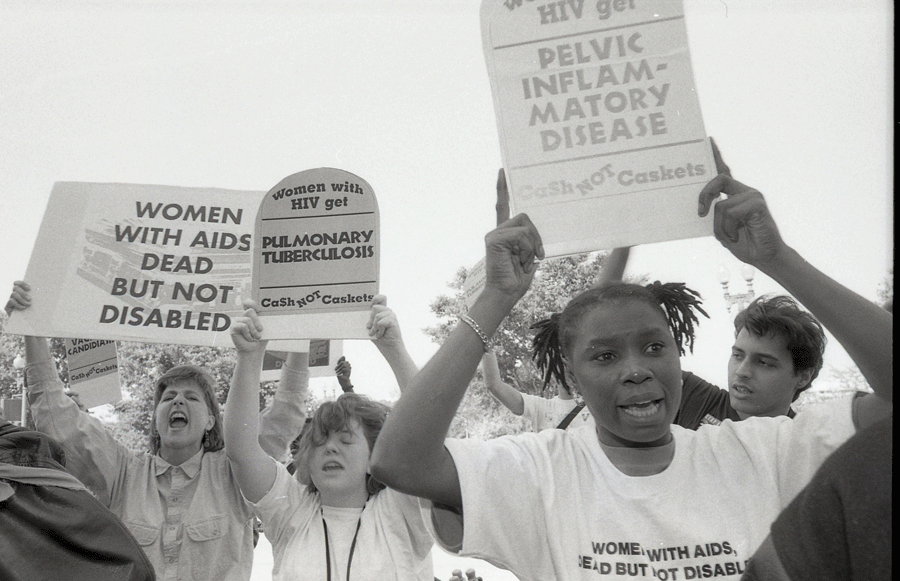
The popular image of AIDS activism, represented in pieces of media such as How to Survive a Plague, Angels in America, and The Normal Heart, is an individualistic one. It frames activism as a response to a young, white, gay man withering in a hospital bed while nurses refuse to touch him, fearing they would get AIDS. Women are often excluded from the narrative entirely, or are at best remembered as caretakers who donated blood to gay men. In reality, women were leaders in AIDS activism and were instrumental to the movement’s success.
From 1981, when Acquired Immunodeficiency Syndrome (AIDS) was first recognised as an infectious disease in the United States, to 1990, there were over 100 000 AIDS related deaths, and AIDS became the leading cause of death of young adults.
ACT UP (Aids Coalition To Unleash Power) was a non-violent direct action group that was formed to combat a wholly ineffective government response to this crisis. The organisation was primarily led by HIV-positive gay white men like Larry Kramer, who is seen as the founder, and Peter Staley, a former Wall Street trader, who were able to use their social privilege and connections in their activism.
They fought for lower drug prices and better access to experimental drug trials through direct action protests. Notably, they disrupted the opening bell of the New York Stock Exchange with foghorns and displayed a banner reading “Sell Wellcome.” This was a reference to Burroughs Wellcome, the manufacturer of the only approved AIDS drug at the time, which had priced their drug at over 10,000 dollars a year. ACT UP also protested at the FDA and NIH to fight for greater inclusion of people with AIDS in conversations around AIDS research. Ultimately, they succeeded in creating relationships with medical institutions and expanding drug access.
But young, white, gay men were not the only people affected by AIDS—other communities had different needs in terms of AIDS activism. As ACT UP was horizontally organised, women activists established an ACT UP Women’s Caucus to focus on specific issues that were important to them.
Women’s voices and lived experiences were often ignored in favour of the priorities of gay white men, even within ACT UP itself. Activists who were men often prioritised obtaining healthcare and pharmaceutical information that was relevant to them over issues that affected women or other marginalised groups. When organising a protest concerning the lack of research into medication for women with AIDS at the International AIDS Conference of 1990, women were told that they should not disrupt the talk itself, since useful information could be shared (Schulman, 2021). Instead, women were relegated to holding banners and wearing spray-painted shirts as a sign of protest against their exclusion.
This prejudice also extended to the way ACT UP interacted with the media. When it was suggested to one of the gay men in ACT UP to refer to a woman or person of colour to answer media questions, he responded, “But… wouldn’t it be better to use our best people?” (Schulman, 2021) Instead of spending time educating their counterparts and combatting their prejudices, women focussed their efforts on organising using ACT UP’s resources to make a difference in their own lives.
The definition of AIDS established by the Center for Disease Control (CDC) was symptom-based, and thus fundamentally exclusionary of women, intravenous drug users, and people of colour. Particularly, there were specific organ-based symptoms of HIV infection, including repeated yeast infections, endometriosis, and uterine tumours that were not included in the CDC definition. This led to them both being denied access to critical clinical trials that would have advanced research about women and HIV, and disability benefits provided by the government for those who were too sick to work. Thus, this was an important focus of activism for women with AIDS.
Terry McGovern, a lawyer who started the HIV Law Project, brought a landmark class-action lawsuit (S.P. v. Sullivan) against Social Security, which forced them to include HIV-related disability in their criteria. She also challenged the early FDA guidelines on excluding women with childbearing potential from clinical trials, another significant barrier for women.
A protest organised outside of the Department of Health and Human Services showed a light on how women were both denied access to disability benefits, but also lacked specific research and treatments. The slogan was “Women don’t get AIDS, they just die from it,” a representation of the broader issues facing women within AIDS activism.
Women also acknowledged the intersectional nature of their movement. Katrina Haslip was an HIV-positive Black woman who discovered her HIV status while incarcerated. She fought for HIV-positive women to have better access to peer support in prison, and founded the AIDS Committee for Education (ACE) to support incarcerated women, along with its counterpart ACE-OUT for formerly incarcerated HIV-positive women.
The women also brought critical experience from previous activist movements to their work. Maxine Wolfe and Sarah Schulman both came to ACT UP with experience from the Women’s Health Movement. Women activists used methods such as teach-ins to describe the lessons to be learned from the Women’s Health Movement, and how to apply that to feminist activism within ACT UP. This resulted in the handbook Women, AIDS, and Activism, which gave HIV-positive women specific healthcare information and went into detail on issues such as safe sex, transmission, race and ethnicity, etc. This also gave men within ACT UP the ability to learn from women with activist experience about how to improve their movement.
A turning point came at the “Storm the NIH” protest in May 1990, which focussed specifically on expanding research on how AIDS impacts women and people of colour, and their underrepresentation in clinical trials. Activists were able to organise the First National Conference on Women and AIDS conference in December 1990, but their voices were still systematically ignored by medical professionals. It was not until 1993 that the CDC agreed to amend their definition of AIDS to include a T cell count under 200 and some of the organ-specific symptoms, both of which were key demands of the women of ACT UP.
Much of this important oral history has been preserved through the ACT UP Oral History Project, created by Sarah Schulman, an important member of ACT UP New York, which has hundreds of hours of individual interviews with surviving ACT UP members, as well as documentary footage of protests of the time. This has been synthesized into a book also by Schulman called Let the Record Show and a film directed by Jim Hubbard, United in Anger: A History of ACT UP, which both draw on the Oral History Project.
The efficacy of their direct action, intersectionality and inclusion, and horizontal organisation are all lessons that can be learned from the powerful women in AIDS activism for activist movements today.
Photo Credit: https://womanatthereel.com/nih-women-def160-copy/
Other posts that may interest you:
Discover more from The Sundial Press
Subscribe to get the latest posts sent to your email.