
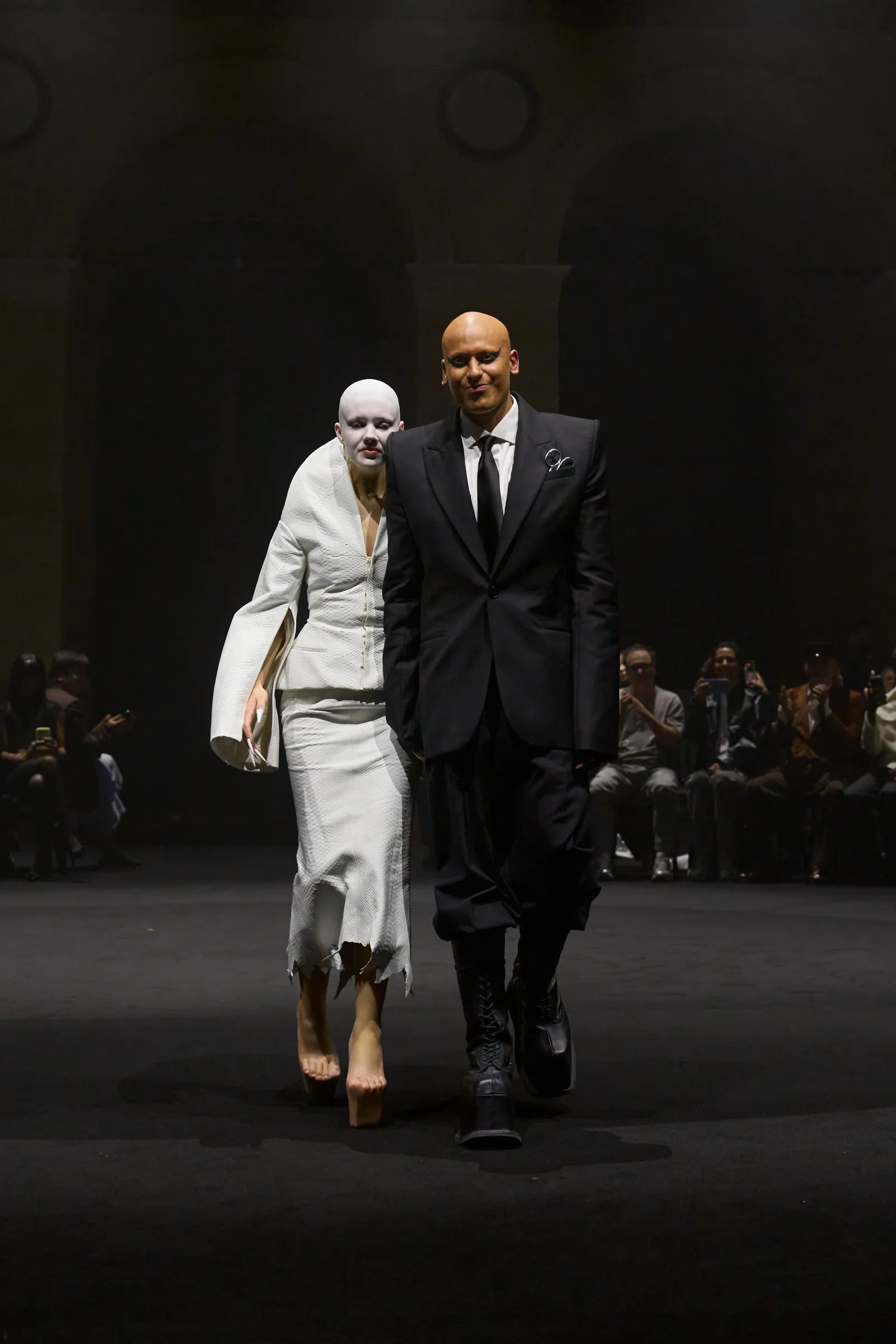
Blood-stained opera gloves, grotesque results of going under the knife and razor-sharp tailoring. This is not your regular runway show. This is Matières Fécales.
The designer duo of Hannah Rose Dalton and Steven Raj Bhaskaran, collectively known as Fecal Matter, introduced the Fall / Winter collection of their fashion label Matières Fécales, titled “The One Percent” at Paris Fashion Week 2026. Their introduction of the show reads: “Power affects us all. Whether it’s the corruption of power by those who lead us or the lack of power from those who seek it. We all have a relationship with it and that’s ultimately what this collection is about.” This article will dig into the underlying themes of the aforementioned collection and will aim to inspect the political implications of fashion.
Matières Fécales is a Parisian fashion label that was founded by Dalton and Bhaskaran; who met in 2014 when studying fashion design in Montreal. Their journeys towards fashion, even if coming from entirely different environments, were driven by the same thirst for freedom and expression. Dalton, while coming from a wealthy background, struggled within a strict catholic environment and noted the exploitative nature of the fashion industry as a motivator to pursue fashion design. “I started sewing because I thought to myself: “I’m not going to buy anything and I’m going to make my own clothes, so I’ll know how they’re made, that they’re not hurting anyone or keeping kids out of school,” she said. Bhaskaran, in turn, has referenced his rough experience in a working-class single-parent household and socio-economic struggles as a person of color, which pushed him to seek ways of self-expression in art, specifically drawing and eventually sketches of clothes. The two artists both credit their relationship as the key factor that enabled them to be true to themselves, both internally and externally. Currently, the pair is known for their striking, almost alien look, both having shaved their heads and often showcasing heavy makeup. Hannah embraces a fully white face-paint look, with monochrome white or pink tailored clothing, while Steven opts for dark and oversized silhouettes. They have truly established themselves as provocateurs, who are not afraid to embrace this alias without reservations.
The label, of course, reflects the approach its founders make to their art. Matières Fécales leans into their “post-human” aesthetic and aims to exist according to the “dogma of fearless expression”. Their garments are futuristic and innovative, with a heavy focus on reimagining couture tailoring, challenging the politics of beauty and addressing various social issues. The label name, as highlighted in their own introduction, “captures the beauty and grotesque of the human experience while challenging the glossy facade of a luxury driven culture.” Steven Raj also comments on the comic and somewhat puzzling undertones of the name: “It literally means ‘shit’,” he laughs, “but for us, the concept has always been duality. To make that work, the clothes have to be well made – that’s the only way a name like ours makes sense in a luxury space.” Despite being active for more than a decade, the designer duo only gained their chance to introduce their creative world to the high fashion audience in 2025, as the brand debuted at Paris Fashion Week with its F/W25 collection “The Other”. Since their successful start, Matières Fécales has presented two other collections, one of which – the F/W26 collection – will be dealt with here in more detail.
“The One Percent” unraveled in Palais Brongniart in Paris and was constructed around three theatrical acts, which focused on the “tableaux” of Power: the power of archetypes, the power of community and the power of the future.
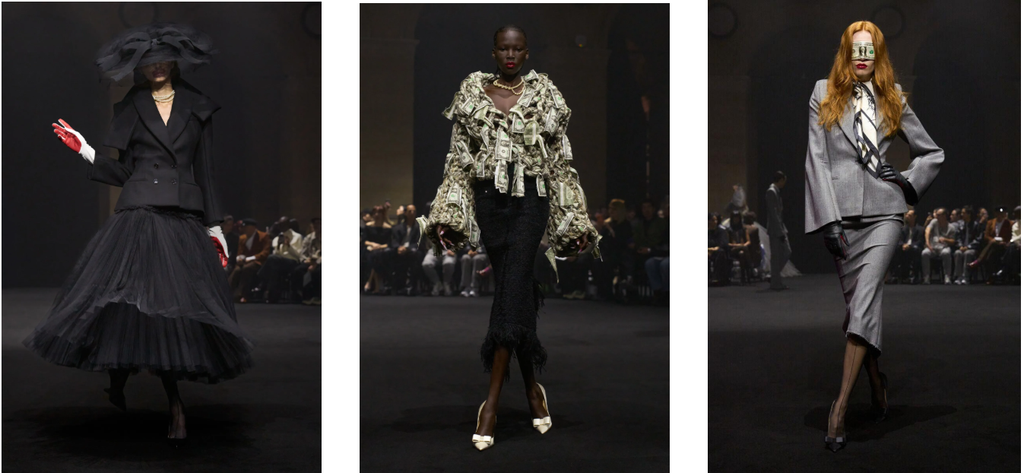
The first part of the show features a disturbing rich (or disturbingly rich) family. The garments are predominantly tailored pieces, resembling traditional couture and Dior-esque silhouettes, such as The New Look of 1947, which is a nod towards attire traditionally associated with upper-class environments and luxury. These seemingly classical pieces, however, are paired with unsettling details, a process Matières Fécales refers to as fecalization, which implies hidden danger and presents a distorted image of the upper-class, indicating a presumably twisted and morally ambiguous inner world, often hidden by their luxury attire. Some looks (no.1, no.4, no.11) feature opera gloves with bright red palms, titled “Guilt Gloves”, while others present elaborate pearl jewellery designs, disturbing for its simultaneously violent and sexual implications (no.14, no.16). These details highlight the exploitation and cruelty performed by the powerful circles, possibly referencing examples such as the Epstein files, as well as the usage of glamour to conceal various crimes. Additionally, some garments reference excessive financial wealth and notions of being blinded by money to the horrors unfolding in the general society. The collection features money-related pieces, such as dollar-bill eye-masks (no.18, no.22, no.23) or the dollar-bill jacket (no.21). Many of these looks also show models with supposed extreme plastic surgery (no.13) and other bodily modifications, which enhances the unsettling demeanor of the rich and powerful by both highlighting their molding into grotesque creatures, reflecting moral decay, and also noting their access to aesthetic modifications, that are unreachable for the general public.
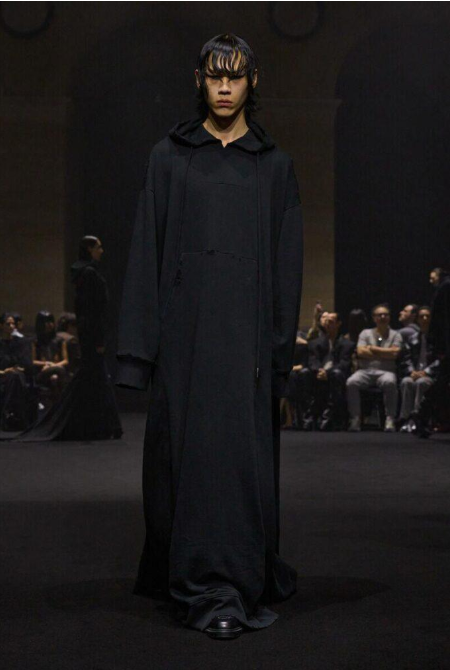
The second part of the show is said to represent the power of the community. Matières Fécales’ journey towards establishment within the industry has been heavily reliant on the support from their audience. Due to this, the designers featured their own friends and family in freeform designs with hoodies, capes and elongated sleeves (no.29, no.31, no.35). These garments were said to be pieces worn by “the powerless” in a world dictated by the 1% as a way to survive the “disturbingly conservative times” and hence find shelter in community and self-expression, something that is largely familiar to the designers and can be a powerful idea in the context of the capitalism-driven and individualistic current society.
The final part, focused on the power of the future, enters the darkness of the fecalized Palais Brongniart in the form of “The Immortals” – the part of the 1% who “have access to tools of life that most of us don’t” as presented in the runway show introduction. Opened by Hannah Rose Dalton herself (no.40) in an albino python skirt suit and the Matières Fécales signature heelless skin boots, the final act of this grotesque play returns to the design roots of the label with more renditions of the heelless boot and variations of brand-specific dramatic tailoring (no.42, no.46, no.48, no.54). These looks, in true Matières Fécales fashion, challenge what we see as luxury in the first place and questions the future of glamour expectations and criteria, which could be taken as analysis on cultural capital and soft-power in the age of aesthetics. This part also features some famous figures such as the American entrepreneur Bryan Johnson (no.45), best known for his excessive endeavors in the pursuit of anti-aging. Here, however, he also seems presumably oblivious about the irony in his modeling debut in a fashion show on questionable billionaire activity. Perhaps all press is good press. The show is closed with an all white look, which as explained by Steven Raj, is a reference to Elizabethan royalty dress (no.55), which ties together the overarching theme of this collection regarding cultural and political commentary on the rich and powerful.
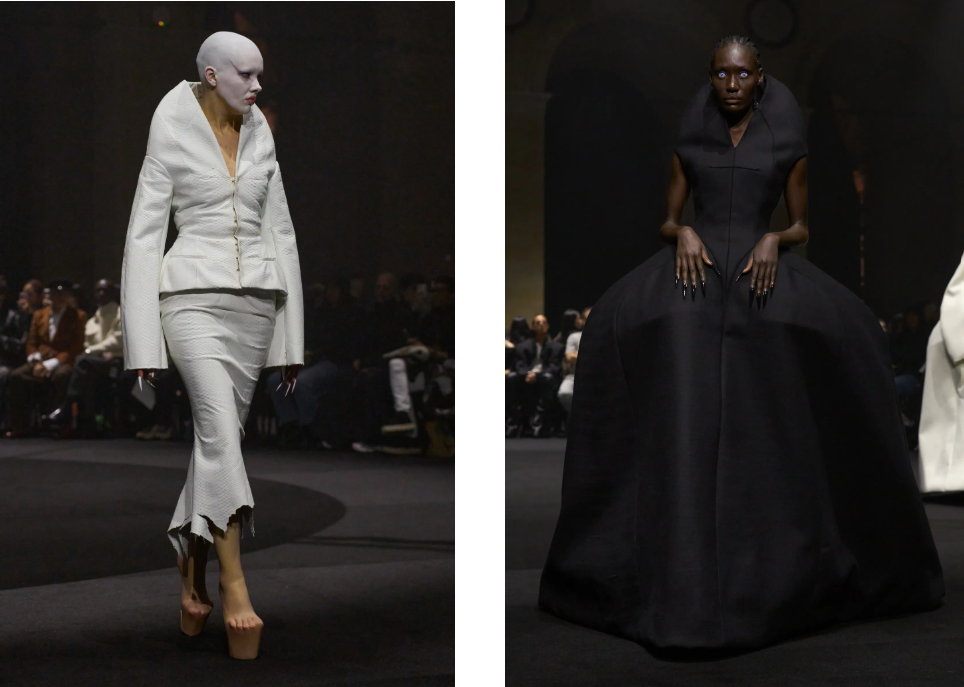
The One Percent, as well as Matières Fécales in general, summon the politics within fashion by utilizing the powerful tool of provocation. This show is not only a direct critique on the cruel power of the rich, in the form of grotesque exposure of moral decay, but also commentary on class, societal perceptions, belonging and the beauty of self-expression. While bursting with professionally crafted critique of flawed power relations in our society, this show nevertheless deserves questioning: one must acknowledge the dichotomy within the message of the designers, who are selling class consciousness and political awareness undertones to the same upper-class that sits in their front row. Regardless, Matières Fécales is undeniably accurate in portraying the rich as repulsive yet attractive, unsettling yet intriguing. At the end of the day, EAT THE RICH continues its echo, as long as the words taste a little sweet.
Photo credits: Gorunway.com
Taken from the article “I Can’t Stop Thinking about Paris Fashion Week’s Most Controversial Show.” (March 4, 2026) by Dukic, Tara on VOGUE ADRIA
Other posts that may interest you:
Discover more from The Sundial Press
Subscribe to get the latest posts sent to your email.