

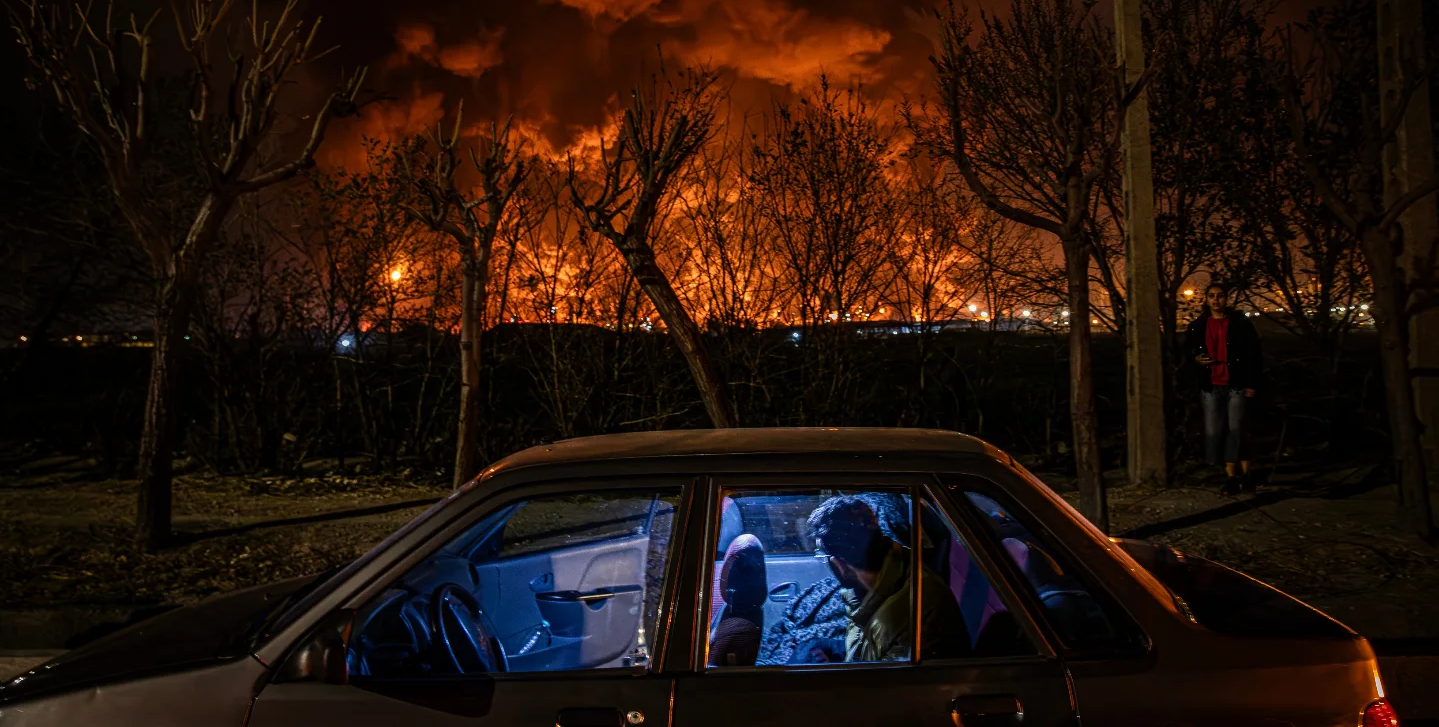
It seems all too familiar: another war for regime change, another crisis in oil prices, another nuclear weapon ‘threat’, and another conflict that will devastate human lives and the environment. Just days into the United States and Israel’s “preemptive attack” against Iran, harrowing images from the country’s capital city of Tehran show orange flames reflecting off suffocating black smoke, as oil-storage facilities were set ablaze. At the same time, gas prices surge worldwide as millions of barrels of oil are blocked from passing the Strait of Hormuz, a critical shipping route in Iranian territorial waters. Amid all of this, we are all left wondering how we let this happen again. 53 years since the OPEC crisis tanked the US economy, 51 years since the first report on human-caused global warming, and 16 years since the Deepwater Horizon Oil Spill (the biggest maritime spill in US history), we still cling to a fossil fuel reliance that has only brought about death and destruction.
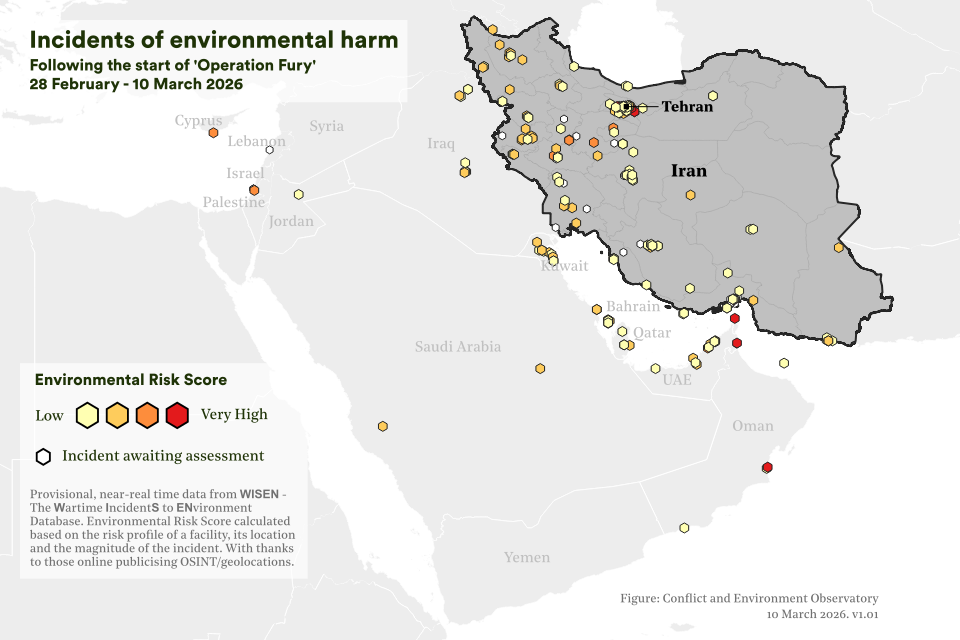
War has always been a source of environmental disaster–increasingly so as warfare tactics become more destructive. While it is still impossible to quantify the extent of the environmental devastation, experts have already begun to warn of the direct impacts of the conflict in Iran on ecosystems and access to critical resources. As seen in Tehran, explosions involving oil infrastructure result in unbreathable air and acid rain. Microscopic soot particles pose a respiratory and cardiac threat in the short term and increase the risk of cancer in the long term. Heavy metals in the contaminated air and precipitation seep into the soil and risk contaminating water supplies. Additionally, attacks on desalination plants, which much of the Persian Gulf relies on, have threatened the freshwater supply of millions. Sunken ships release toxic chemicals, threatening fragile habitats below the surface. Any attacks on nuclear facilities could also have long-lasting fallout. The enormous loss of human life and biodiversity associated with this war is clear, and the situation is only getting more dire by the day. We are witnessing an eco-cide: the weaponization of the environment and the access to basic resources against innocent civilians caught in another rich man’s war.
But the harms are not just restricted to these direct impacts. New analyses from the think tank Climate & Community Institute find that the equivalent of 5 million metric tons of carbon dioxide were emitted in the first 14 days of the conflict–more than the annual CO2 output of the 84 lowest emitting countries combined. At the very same moment that President Donald Trump was authorizing these emissions on a non-congressionally-approved war, the western US was hit with record-high temperatures, while Hawaii faced the worst flooding in 20 years. In case you needed more proof that these men do not care about what they destroy in their quest for power, here it is. As the researchers who reported about the high carbon cost of the war put it, “no matter which of the many reasons Trump has since provided for attacking Iran, the US intervention in Iran is now clearly about oil.” Just like Iraq, Afghanistan, and, more recently, Venezuela, oil has been the undercurrent driving the US (and the West as a whole) to invade, overthrow, and plunder. As long as war (and oil) is profitable, this cycle of violence will never end.
The reality is beyond heartbreaking, but it is in moments like these that we must turn our rage into action. For too long, our fossil fuel dependence has dragged us into conflicts, perpetuated economic instability, exacerbated injustices, destroyed life-sustaining systems, and caused mass-scale suffering. This war is simply the next installment of a cycle of death and destruction that has existed for centuries. Ending fossil fuel reliance is not “just” about protecting the natural world. It’s about making it so no parent has to grieve their sons or daughters, whether they went off to fight in a needless war over oil, or simply to school in whatever country becomes the next target. It’s about confronting the cost of living crisis so that people do not have to decide between filling up their tank and buying groceries. It’s about making energy, food, and water available to all so that countries have neither the power to cause nor a vulnerability to deadly resource shortages. It’s about building a safer and more just world, not solely for ourselves, but for generations to come.
We must recognize the way that war, environmental destruction, and fossil fuel reliance all intersect. With no interest in a future they won’t exist in, and no care for those without a voice to fight back, the hands of the men in power are stained with the blood of the victims of war today and climate change tomorrow. And in their hearts, there’s only oil.
This article was first published as part of the Sundial Press printed edition in Spring 2026
Photo Credits: Erfan Kouchari
Other posts that may interest you:
- All Eyes on Women’s Sports
- Our Deadly Addiction
- We Are All Epstein Victims
- No, Caring About the Planet Is Not A Hobby!
- The Freedom We Take For Granted
Discover more from The Sundial Press
Subscribe to get the latest posts sent to your email.