

As fifty 1As crowded into C201—the little lecture hall next to the Old Library—excited chatter began. The spectacle awaiting them was a brand new event hosted by the Sciences Po Debate Union (SPU). Having marketed it as a way to study two hours worth of content in only forty minutes, this debate aimed to prepare students for their first midterm: Sociology.
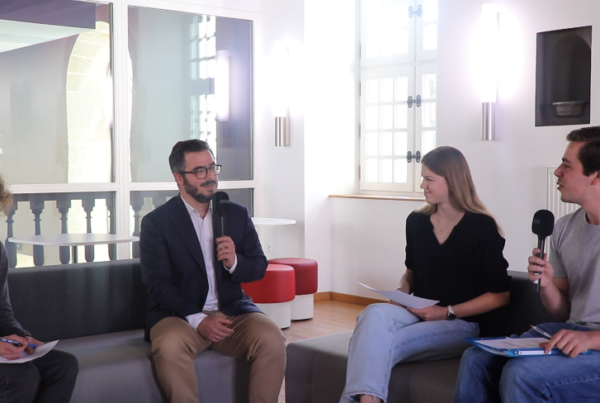
At the front of the room stood debate moderator and Head of Training Karlīna Jansone, Co-President Thom Lolkema, and three brave SPU babies: Juliana Wang, Dominykas Smaliukas, and Delia Sawatzki. Each of them was set to portray one of the four key sociologists studied during the course: Juliana as Émile Durkheim, Dominykas as Irving Goffman, Thom as Karl Marx, and Delia as Pierre Bourdieu.
They were jotting down last minute ideas and practising their parts as the clock hit 19:05, initiating the “blitz” debate. Unlike in regular British Parliamentary debates where four teams of two compete over a single prompt and have a seven-minute speech to make their argument, debaters are able to respond to the multiple prompts and to each other as they wish. With this, the debate started with a prompt directed at the four people at the front of the room: “a person’s social environment shapes them.”
Unsurprisingly, Marx immediately began talking about the all-important nature of class. Bourdieu jumped in after him, remarking, “you think you just fell out of a coconut tree? You exist in the context of all in which you live and what came before you.” She used this quote from “America’s biggest fumble, Kamala Harris,” to begin discussion of Bourdieu’s theory of habitus. Goffman agreed but claimed, using his theories of line and face, that meaning in a social environment comes from interactions. Durkheim argued that all of them were creating unnecessary complications, stating that social norms come from society at large.
This continued for about half an hour, with further prompts focusing on economic divisions, social power, social order, and the performativity of society. Memorable moments included Bourdieu’s allegation that “[Marx] might have begun [the study of class], but I ended it,” Durkheim declaring to be the first sociologist while asking to “see a revolution” before Marx keeps “yapping,” and Marx’s claim that Goffman isn’t a “real” sociologist. To conclude his remarks, Marx stated, “when the capitalists make Labubus, we buy Labubus” which drew laughs from the crowd. By the end of the debate, the audience had been treated to both an enthralling performance and a thorough review of the four sociologists’ key contributions.
After posting a story on the SPU Instagram account asking the group to vote for their favourite “debater slash sociologist,” the winner was declared: Thom, as Marx, with his witty remarks and a ceaseless focus on class, had won. Delia, as Bourdieu, was a close second.
Karlīna shared that SPU’s goal was to “animate” the subject, stating, “it’s one thing to see text on a page, but it’s entirely different to associate [the academic material] with a person, a face, a voice.” Students were very responsive to this teaching method. One said she found it was a “good way to see how different ideas of different sociologists interact.” Another, Wufei Xu, agreed, stating it was a “really good recap of a lot of the main points that each sociologist [makes].” Delia added that her preparation “focus[ed] on actually including content,” which was strongly appreciated by the audience. Thom mentioned that, as a 2A, preparing for the debate and “seeing the slides from Godechot kind of like, [brought back unpleasant memories].” Overall, he enjoyed the debate, joking that playing Marx “made me a lot more class conscious,” as did Delia, who said “it’s kinda fun to pretend that you’re a sociologist!”
Students also seemed eager for similar events in the future, with one specifically mentioning her interest in a session focused on Political Institutions (PI). Karlīna noted that “[SPU will] be doing an open-book PI-inspired practice debate before the PI midterm…since PI is highly similar to material usually covered within debates.”
As SPU looks to the future, they plan to continue with regular practice debates and participate in a few tournaments: three in the UK in November—at Cambridge, Oxford, and the London School of Economics—and a collaboration with another debate association in Paris.
Photo Credit: Yula Sugai
Other posts that may interest you:
Discover more from The Sundial Press
Subscribe to get the latest posts sent to your email.