
It all began at 10:09am on November 13, when North America minor program manager Giulia Verardi sent an e-mail to the students of 7 first-year quadruplettes. In it, she stated that the quadruplettes concerned would see their Classical Texts of Political Theory final exams, originally scheduled for 2:00pm the next day, November 14, delayed to November 28. Ms. Verardi cited a “breach of equity among students” caused by some instructors allegedly giving their quadruplettes information on the texts which would appear on the exam. For the Classical Texts course , each instructor prepares their own exam.
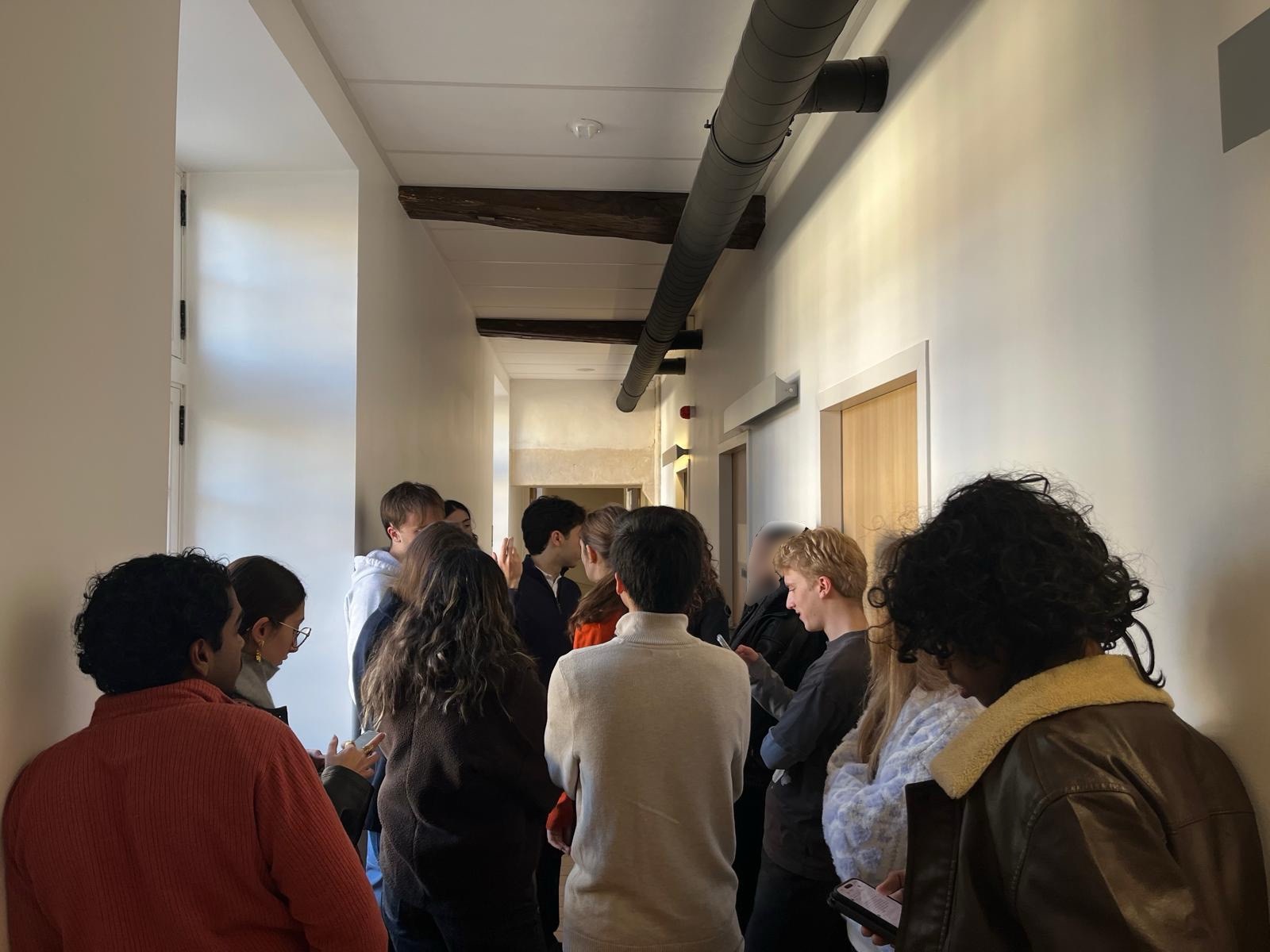
The last-minute change in schedule provoked immediate backlash from the 1A student body. One student, writing in a group chat, described the situation as follows: “There is just way too much content being stuffed down our throats with no organisation whatsoever.” Following this reaction, North America minor student representatives Aanchal Batwara and Jaime Avancena headed for the office of Ms. Verardi at 11:30am. They were joined by about a dozen more students. At about noon, campus director Pierre Catalan arrived, informed the group that Ms. Verardi was working from home, and invited everyone to the A building’s conference room.
The Noon Meeting
The meeting between the student representatives, other students, and Mr. Catalan lasted approximately 30 minutes. Mr. Catalan explained that the administration had learned of teachers “giving too much information [about the exam]” on the morning of November 12. He elaborated that the option to move the affected quadruplettes’ exams to a weekday had been looked into, but ultimately rejected due to a lack of available timeslots.
Mr. Catalan’s remarks were followed by Ms. Batwara presenting the representatives’ alternative propositions. The first, which would have entailed everyone being informed of the exam topic so that the November 14 exam could go ahead for all students, was rejected by Mr. Catalan on grounds of inter-campus equity. The second, moving all exams to class sessions with different subjects, was also rejected, this time for the difficulty it would pose in accommodating students with extra time, as the exam would last exactly two hours. The representatives, as well as all other students, accepted both objections, and Mr. Catalan moved on to his own proposals.
The campus director offered the group of students three options. The first idea was allowing affected students to defer the November 28 exam without providing documentation, in effect allowing them to choose between November 28 and December 8. The second option was changing all exam topics and holding the exam on November 14 for all students. Both were rejected by the group. Mr. Catalan’s third suggestion was to find suitable weekdays for affected students and deal with accommodations on a case-by-case basis. The students appeared amiable to this proposal, and the discussion continued along these lines.
Ms. Batwara stressed the importance of giving students a choice and recommended giving them the option to take the exam either on November 21 or November 28. Mr. Catalan concurred with the importance of allowing students to decide, and proposed the following: students unaffected by divulged information could choose to take the exam on November 14 as scheduled, on November 20, or on November 21. Students affected would have to choose between November 20 and 21. Mr. Catalan did make a point to stress that the specific dates of November 20 and 21 were unconfirmed and that he would have to check them with the planning department. However, both the students and Mr. Catalan agreed on a plan broadly along these lines, focused on giving students choice. The campus director confirmed that students would be excused from any classes clashing with weekday exams, that no one would be forced to take the exam on November 14, and that all exams would cover sessions 1-6. He also gave a commitment to talk to classical texts instructors and work on a “normalization of the workload.”
The Plot Thickens
The conclusion reached at the conference was communicated by Mr. Avancena to the MINAM 1A WhatsApp group at 12:30pm, leading to widespread relief in the student body. However, it was not to last. By 5pm, rumors had begun circulating that the agreement was in peril. By 5:22pm, it was as if the noon meeting had never happened. At that hour, Ms. Verardi sent an e-mail moving the classical texts exam to November 28 for all students, with deferrals set for December 8. This meant that even the students unaffected by instructors’ divulging of information would not sit the exam on the scheduled date of November 14. She cited the credibility and fairness of exams, the sustainability of logistics, and the well-being of students as reasons for the decision.
The 5:22pm e-mail set off a flurry of student activity in group chats and on campus. Everyone seemed to have a different specific issue, but the vast majority was united in expressing a common feeling: indignation. It felt as though the rug had been pulled out from under them. One student wrote: “How are they preserving our well-being like that? I don’t understand them. Why can’t we just take it tomorrow if we want to?” As in the morning, Ms. Batwara and Mr. Avancera rushed to talk to Mr. Catalan. However, the campus director was attending a panel discussion on education hosted in the main amphitheater between 5:00 and 6:30pm, so they would have to wait.
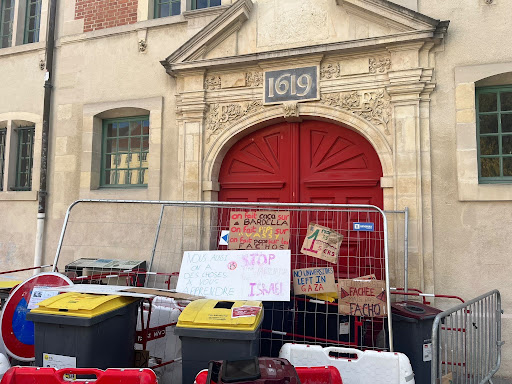
The moment came at 6:45pm, when the student representatives, along with a group of about 20 students, met with Mr. Catalan outside of the CROUS cafeteria. Much of the discussion focused on students’ concerns about mental health. “I just want the midterms to be over,” was one sentiment shared by many. Above all, though, students demanded answers as to why the noon accord had seemingly been voided. Mr. Catalan explained that the planning department was unable to arrange, on such short notice, exams for November 20 and 21, with the latter date specifically conflicting with sports association events. Furthermore, he clarified the reason November 14 was cast aside altogether: allowing the affected students more time to study would be unjust. Tensions rose on this point, as students asked why the administration couldn’t just give everyone a choice over whether to sit the exam on November 14 or not, as had been the understanding at noon. They also claimed that the students who would be negatively affected by this change were a clear minority. Mr. Catalan responded: “We live in a world where twenty people can block a campus of one thousand,” referring to the wave of blockades the Reims campus has experienced since early October. This provoked anger among students, but debate moved on amid calls to focus on the future instead of the past, with everyone eventually accepting the annulment of November 14 as a fait accompli.
Most importantly, Mr. Catalan confirmed during the discussion that the date of November 28 was not definitive. He stated that he viewed that date, as well as the deferral date of December 8, as the “worst case,” and promised to work with student representatives to find a solution in the coming days. Both Mr. Catalan and the representatives remain in agreement that the best option would be designating one weekday and one weekend day for the exam and its deferral. November 20 remains one of the dates under consideration. Students will, in any case, keep their right to defer the classical texts exam without providing a certificate, and to be excused from any classes conflicting with exams.
Speaking to the Sundial Press after the 6:45pm meeting, Mr. Catalan stressed the importance of protecting the exams’ credibility and fairness. Ms. Batwara, for her part, conveyed optimism, describing the meeting as the “best ever” and expressing confidence in the administration’s sincerity in finding a solution. But while there seemed to be common ground found on the specific issue of the classical texts exam’s date, many students remained frustrated by the whole episode. One, speaking on condition of anonymity, told us: “It shouldn’t be this hard to standardize a test in the 3rd best political science university in the world.”
Publication note: The Sundial Press is aware of a similar “leak” concerning the exam subjects of the 1A French Africa minor classical texts exam. As of time of going to print, no decision to delay those exams, still set for November 14, had been taken.
Photo credit: Ogan Göncü
Updated information from Pierre Catalan: The campus staff has investigated and there was no breach of equity or subject/text leak to students in the MinAf program.
Other posts that may interest you:
- Reims Campus Blockaded Amid Nationwide Student Mobilization
- Sciences Po Votes: What does each list stand for in the council elections?
Discover more from The Sundial Press
Subscribe to get the latest posts sent to your email.