
Whether Timothée Chalamet likes it or not, opera is far from surrendering to the cliché of an agonizing art form that only wealthy elders care about.
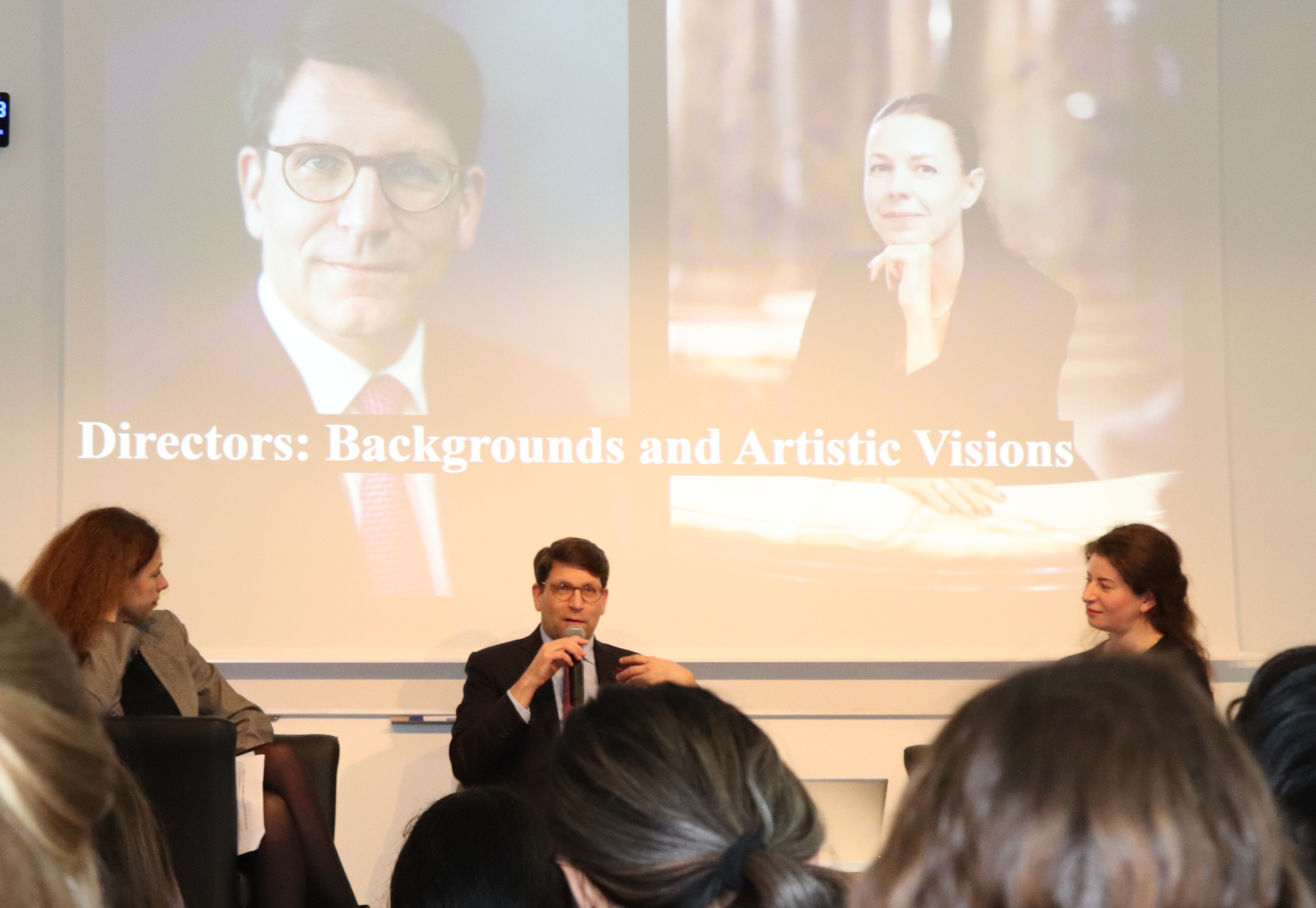
On Friday 13 March, a crowd of 50 students engaged with guests shaping contemporary opera on the ground: Alexander Neef and Aude Accary-Bonnery, respectively Director and Deputy Director General of the Paris Opera since 2020 and 2025. This conference was organized by historian Sandrine Coyez, who teaches two seminars at Sciences Po Reims: “American Art as Soft Power” and “Opera and Politics in the US.” Her students from the latter course attended the conference prepared and asked the guests about the topical challenges facing the Paris Opera, such as democratization, diversity, and sustainability.
Neef and Accary-Bonnery kicked off the conference by presenting key facts about the Paris Opera, which pursues public service missions more than commercial ones and supports creation, artists, and accessibility. The institution comprises in-house artistic assets rooted in French savoir-faire: two opera houses (the Opéra Garnier and the Opéra Bastille), the Ballet School, an orchestra academy, and workshops producing costumes and stage sets. In 2024, the Paris Opera received 40% of its funding from the French State and 28% from philanthropy. Diversifying revenue sources is key to maintaining the opera’s fragile financial balance, which is constantly under pressure from rising labor and production costs. Neef stressed the importance of sustaining a relationship of trust with the State, the sponsors, and the audience, which is “the work of every single day since it’s very quick to break: at the moment you become reactive or offensive, it’s already too late.”
To boost its revenues and target a wider audience unable to come to Paris, the Opera has endorsed digital broadcasting through a partnership with France TV, Pathé Live, and 800 partner movie theaters across the globe, as well as through the creation of Paris Opera Play, a streaming platform broadcasting the opera season and documentaries. As the former artistic director of the Santa Fe Opera, Neef drew transatlantic parallels with the US by referring to “The Met: Live in HD,” the Metropolitan Opera’s pioneering digital broadcast. This innovation eventually led to the loss of the audience that used to commute from neighboring states to spend a night at the Met. To Neef, the essence of opera is being a living art: “Something is happening onstage which doesn’t happen on a screen, also in terms of who you are as an active spectator,” unconstrained by the lens of the camera.
Neef highlighted that contemporary opera serves the same function as Greek catharsis, confronting spectators with complex artworks to help them cope with the complexities of society. As a follow-up, one of the “Opera and Politics” students pointed out that only a privileged elite could afford the right to be enlightened by high-brow art. In response, Neef joked about the first time his daughter listened to a Wagner opera and told him that “it’s like the music in Star Wars.” He said it’s actually the other way around—just as The Ring of the Nibelung inspired the saga’s soundtrack, opera infuses popular culture.
Furthermore, Accary-Bonnery explained that the audience changes every year, and that half of it has never been to the opera before. As a matter of fact, the Paris Opera is dedicated to promoting the democratization of opera by attracting a more diverse audience. For instance, they only raise the price of more expensive tickets because demand is less elastic, since they are bought by wealthier customers (wink-wink Econ revision). Anticipating demographic change is key. Both guests stressed the importance of refraining from resting on their laurels when the opera house is full, and instead planning their strategies to reach a new audience. They pointed out the case of the Met or the Lyric Opera of Chicago, which focused only on curating for its aging, wealthy audience until it realized its houses were suddenly empty.
Since they represent a new generation of spectators more sensitive to issues of diversity and inclusion, some students asked questions about the aftermath of the Manifesto on the racial question at the Paris Opera written by some artists in 2021, and Pap Ndiaye’s subsequent report. The guests explained that new productions committed to current preoccupations are expensive to produce and often less profitable than the popular traditional operas. Hence, their programming offers a classic “safe-value” repertoire as a safety net, which allows them to build a faithful audience that later trusts them to discover contemporary artworks. Besides, the Opéra Garnier is so iconic that many people come only to see the venue, so they use it as a “bait” to push spectators’ limits in artistic discovery.
According to Neef, “there’s always a fine line between art and activism.” Works that strike the right balance between the two are universal masterpieces that endure over time. For instance, he lauded the opera “Nixon in China” by American composer John Adams, which was recently performed at the Bastille. Although it’s the same production as the one programmed three years ago, he finds it much more relevant today than it felt then, and shared that “the piece doesn’t change, but your look does, you find new things every time.”
Far from the stereotypes of a rigid and pompous sector, Alexander Neef and Aude Accary-Bonnery struck me with their unwavering dedication to accessible culture, their openness to dialogue, and their willingness to share their passion with a younger audience. Between Accary-Bonnery, a Sciences Po Alumna with a brilliant career, and Neef, who joked about how he made his way from studying Latin to managing opera houses, both guests inspired Sciences Po students to cultivate curiosity and passion in their studies. The reception of their testimonies certainly showed that people do care about opera, as evidenced by the large number of students who attended Puccini’s Bohème at the Opera of Reims.
Cover photo (from left to right): Aude Accary-Bonnery, Alexander Neef, and Sandrine Coyez.
Photo Credit: Talia Lindsay
Other posts that may interest you:
- The Portrait of Marion Germa
- US Foreign Policy under President Trump’s Second Term in Eight Key Words
- Habemus Papam: What Consequences for International Relations?
- Biased Narratives And Independence Dilemmas: What Perspectives For Greenland?
- A Tribute to the Harlem Hellfighters: When Remembrance Becomes Political
Discover more from The Sundial Press
Subscribe to get the latest posts sent to your email.