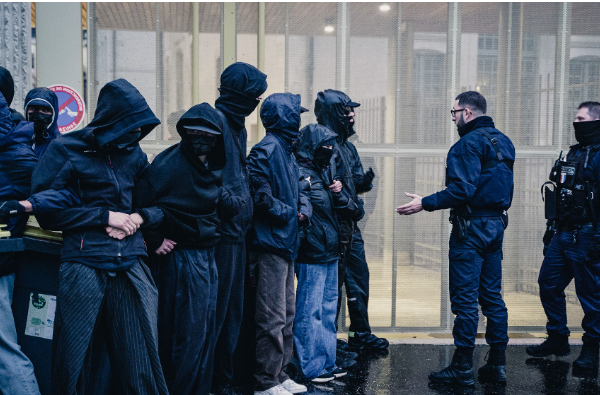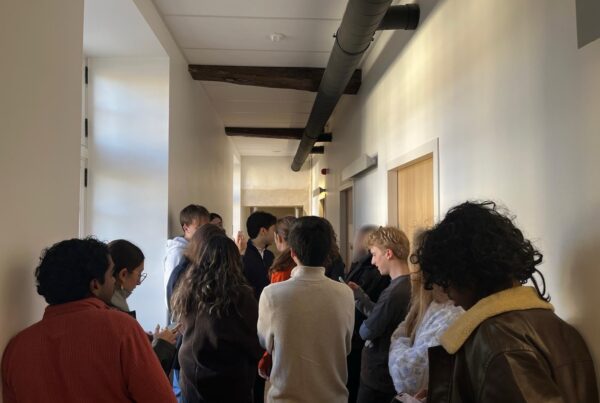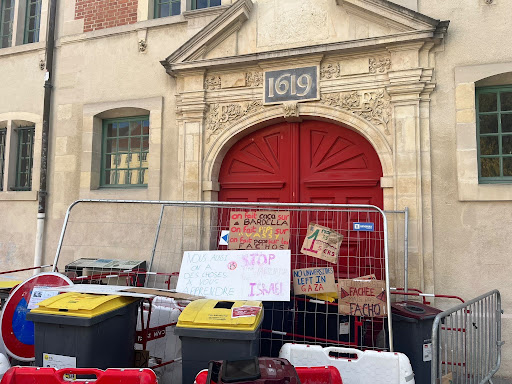

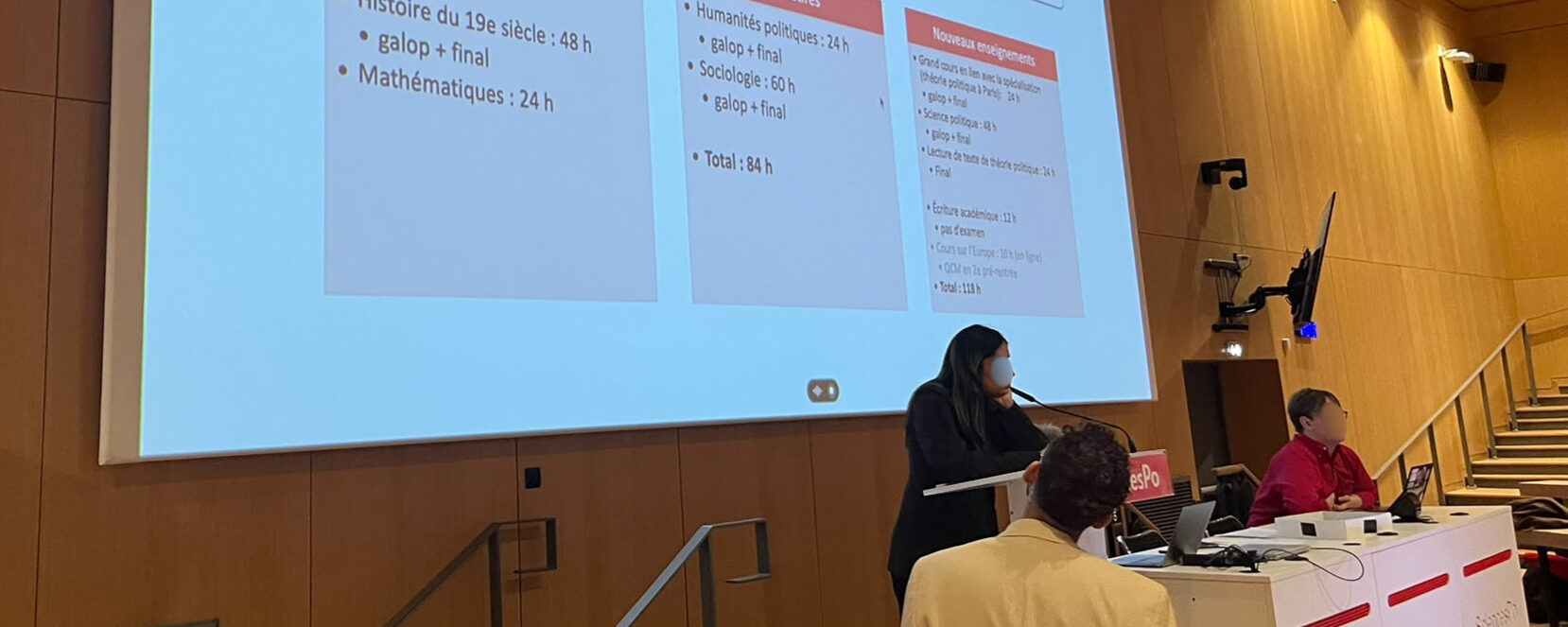
The Sciences Po Reims campus’s first “official” general assembly of the year took place in the large amphitheater on November 18. Organized jointly by student representatives and the administration, there were expectations on both sides that the event would help lower tensions and work towards solutions on a campus rocked by multiple blockades—including one which ended with police intervention—and postponed exams since early October. These expectations were left unfulfilled as a feeling of antagonism between students and the administration dominated the assembly.
The Sundial Press counted approximately 130 people at the general assembly, while student representatives claimed the figure was closer to 200. Seven members of the administration were present. The conference was split into two sections: One hour dedicated to questions by students and answers by the administration, and 20 minutes to discussion among students.
A confrontational start
The moment which set the tone for the entire event came right at its outset, with two statements by the North America minor academic advisor Keridwen François-Merlet. First, regarding a question by a 2nd year on the new curriculum, Ms. François-Merlet said: “Ideally, we want questions to be asked by 1A MINANs.” Campus director Pierre Catalan could be seen briefly grimacing after the remark, which was also met by groans from several students. A few minutes later, in a response to a question about methodology and grading, Ms. François-Merlet again provoked anger among the students, as she appeared to accuse them of “trying to sneak into the cracks and have exceptions” to assessment rules, such as, in this case, the timing of tests. Ms. François-Merlet retreated to her seat shortly after making these comments and Africa minor academic advisor Hamza Bensouda became the principal interlocuteur of the administration alongside Mr. Catalan for the remainder of the assembly.
Mr. Bensouda, though undoubtedly adopting a softer attitude, likewise got off to a rocky start in the eyes of students when, while responding to a question about assessment, he lamented that many students seemed to complain about grades out of a sense of entitlement. Specifically, he said that the administration could “give [students] the numbers” on the amount of emails he and his colleagues received in which students blamed their teachers for getting a 10/20, for example. When asked by The Sundial Press about said numbers, Mr. Bensouda stated that he was only aware of a single such email—from last year—among MINAF students.
Questions, answers, and yet more tension
The central theme covered by the students was academic workload and its impact on mental health. The new curriculum and its application to courses, assessment, and standardization (or lack thereof) of classes between quadruplets were also the subjects of many student questions. The administration, for its part, mostly defended the policies of Sciences Po, while noting that it had been unaware of many of the issues brought up by students. Campus staff additionally affirmed that their email inboxes and offices remained open for specific concerns.
The closest thing to a concession on the part of the administration was when Mr. Catalan indicated his personal preference for lightening the load of the introductory week and reorganizing midterms so that the break would “feel more like a holiday.” The campus director, whose tone was the most conciliatory of any staff member, also admitted that there may be a “problem of communication” between lecturers, teaching assistants, and teachers.
The evolution of students’ questions—from mostly information-seeking queries towards accusatory statements—suggested that they remained unconvinced by the administration. Some of the remarks which got applause from students were: “We are tired, sad, and angry,” “[The] academic writing [course] is useless,” and “[The administration] is not listening.” 1A MINAM student representative Jaime Avancena also felt the need to chime in about the administration’s claims of ignorance. Responding to Mr. Catalan, who had said that he and his colleagues didn’t know coursework was “this hard” until the end of the week before, Mr. Avancena asserted: “Students have been bringing it up to us for a long time. Since last week, we have told them to directly go to you.” This comment was also met by applause from students.
Reacting to the increasingly frustrated nature of students’ remarks, campus language coordinator Sébastien Malagnoux, who made a long statement towards the end of the conference before having to leave prematurely, stated that “it is hurtful to say we are not listening to you” and that all his colleagues in the administration wanted to “make things better for you.”
Takeaways and the future
Mr. Catalan, speaking to The Sundial Press after the general assembly, called the event “useful and productive.” While the campus director stated that some students appeared to conflate what they spoke about in group chats with what the administration was actually aware of, he stressed that students did also have real concerns. Mr. Catalan further emphasized the importance of trustworthy and direct conversation, and reiterated his confidence in the ability of student representatives and himself to bring concrete concerns to the Dean of the University College and the leadership in Paris.
1A MINAM student representative Aanchal Batwara, on the other hand, told The Sundial Press in a written statement that while she was happy with the turnout and the students’ engagement with the issues, she believed that representatives would have to work harder on the assembly’s structure. “I think that at the beginning students were unsure to speak up, and the student reps should have prepared questions and a more helpful structure to guide students,” Ms. Batwara wrote. She further highlighted some of the complaints she had heard from the student body. Namely, that the administration’s responses had been “unclear or flowery,” and that the MINAM program manager Giulia Verardi had not spoken at all. The student representative concluded by promising a second general assembly with changes made in order to use time more efficiently and avoid repetitive questions.
A member of Alternative Étudiant, a left-wing student union which has been sharply critical of the Pierre Catalan administration, told the Sundial Press after the assembly that they found it positive that students spoke up, and expressed their hope that this would translate into “continuous engagement.”
The student representatives of all 7 Sciences Po campuses held a meeting with the dean of the university college, Jeanne Lazarus, at 5:30pm on November 18. The representatives had said, prior to the meeting, that they would be presenting a joint letter to the dean concerning student demands. They are expected to publish the document as an open letter and petition.
Photo Credits: Ogan Göncü
Other posts that may interest you:
- Police Intervention Ends Blockade of Sciences Po’s Reims Campus
- Postponement of 1A Exam Leads to Day of Chaos on Campus
- Reims Campus Blockaded Amid Nationwide Student Mobilization
- Sciences Po Votes: What does each list stand for in the council elections?
Discover more from The Sundial Press
Subscribe to get the latest posts sent to your email.