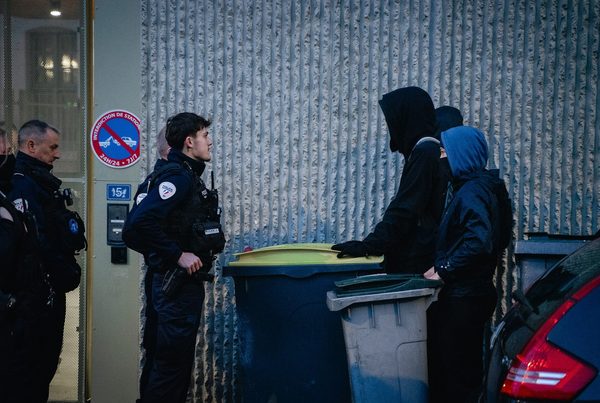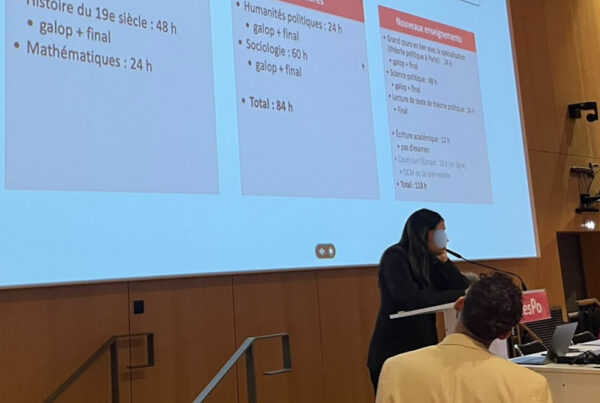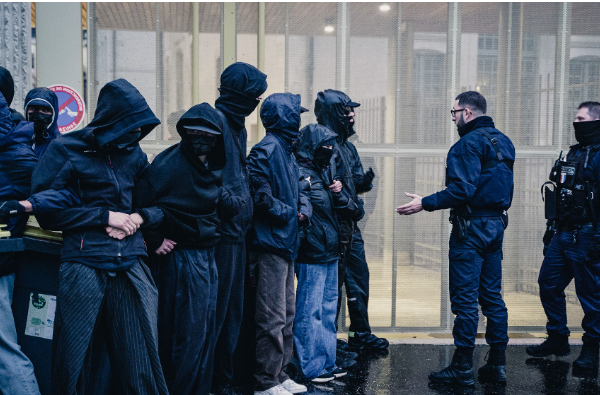

In the morning of Thursday, Oct. 8, campus director Pierre Catalan announced the suspension of in-person classes and a switch to online classes. Classes were moved online due to a campus blockade, which resulted in a temporary closure of campus. Classes took place online on Oct. 9 and 13 as well, but have since resumed in-person.
Although classes have remained in session, for many professors and students, online classes are not an equivalent for their regular in-person sessions.
“Knowledge can still be shared online but it will never be the same, it can’t substitute for the organic interactions of meeting in-person,” said Earl Wang, an assistant professor at Sciences Po Reims, who teaches political science, international relations, and European Union foreign policy.
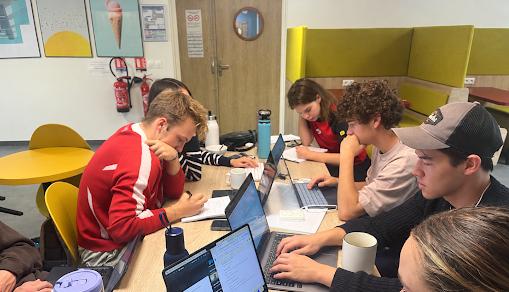
The switch to online classes has been difficult for students, as focusing is often harder during a virtual class than an in-person one. A study from the U.S. government’s National Institute of Health (NIH) found that 95% of students report checking their devices during online courses for off-task purposes, compared to 75% during in-person classes.
“You can get more easily distracted with things at home. You’re not in a strict learning environment, and that can be helpful for some students, but for me I find it distracting and it’s hard to stay concentrated for two hours,” said student Emilie Bataille.
For some students, the switch to online learning has been less impactful.
“I don’t think it has had that major of an impact because the classes have been mostly interactive,” said student Yeshaya Grover.
Despite the challenges of online learning, students and teachers continue to make the effort to make the most of their classes.
“Our presentations have still gone on and students have made the effort to make their presentations interactive. I think teachers have also made that effort on their end,” Grover said.
This week is not the first time students have had to adapt to a virtual class structure, as the Sciences Po campus faced similar closures during the COVID-19 pandemic.
“The situation reminded me of COVID time where we were forced to teach online. Teaching on the screen is never the same as when you’re able to see the person directly, or physically gather in the classroom to learn together,” Wang said.
Although this will probably not be the last time students will have to adapt their learning structure due to unforeseeable circumstances, students have demonstrated their adaptability and determination in overcoming unideal learning circumstances and continuing to pursue their education.
“Please give my gratitude for the students who accompany me online, who still show me their willingness to partake in the class discussion,” Wang said.
Photo credit: Linda Reeder
Other posts that may interest you:
Discover more from The Sundial Press
Subscribe to get the latest posts sent to your email.